The methodology of multi objective design of active-passive shielding system for overhead power lines magnetic field in residential buildings space based on metaheuristic optimization method
DOI:
https://doi.org/10.20998/2074-272X.2026.2.06Keywords:
overhead power line, magnetic field, combined electromagnetic active and passive shielding system, design computer simulation, experimental researchAbstract
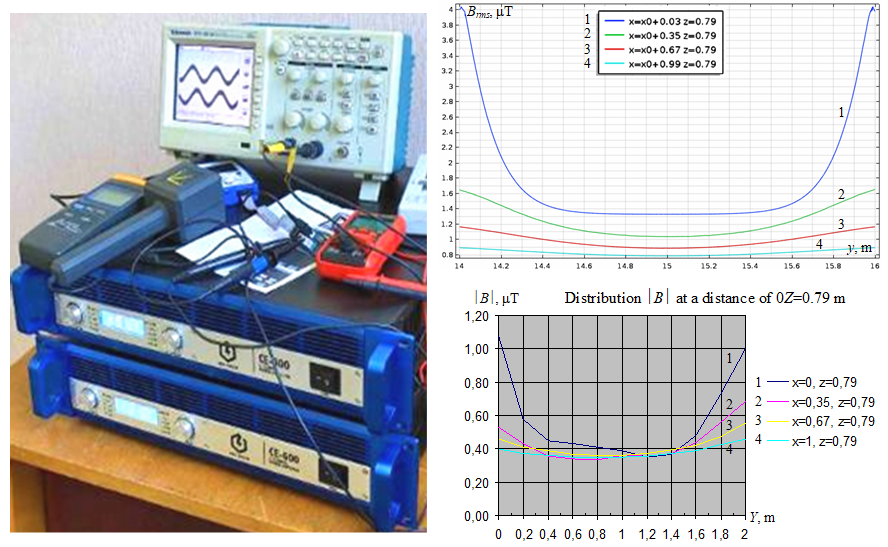
Problem. Most studies of power frequency magnetic field reduced to safe level in in residential buildings located near overhead power lines carried out based on passive or active electromagnetic shielding, but there is no methodology for designing active-passive systems that include active and solid or multi-circuit passive shields. The goal of the work is to develop the methodology of multi objective design of active-passive electromagnetic shielding system, consisting of active and solid self or multi-circuit passive parts to improve shielding efficiency of initial magnetic field in residential building edges generated by overhead power lines to sanitary standards level. This goal proposed to achieve based on metaheuristic optimization method Methodology. Multi objective design methodology of active-passive shielding system based on solution of the geometric inverse problem of magnetostatics for the resulting magnetic field generated by the transmission line wires, compensation windings of the active shielding system and a passive shield in the form of a solid or multi-loop shield. The geometric forward problem is solved based on solutions of Maxwell’s equation for magnetic field three-dimensional model using the COMSOL Multiphysics software. The solution of the geometric inverse problem of magnetostatics is formulated as a minimax vector problem of nonlinear programming. The solution of the minimax vector problem of nonlinear programming is calculated based on the metaeristic optimization algorithm from Pareto optimal solutions taking into account binary preference relations. Results. During combined active and solid or multi-circuit passive shielding system design spatial arrangement coordinates of solid or multi-loop passive shield and compensating windings, as well as windings currents and phases of active shield calculated. New scientific results are theoretical and experimental studies of a designed combined active and of solid or multi-circuit passive shielding system efficiency for magnetic field created by overhead power lines. Scientific novelty. For the first time multi objective design methodology for combined active and solid or multi-circuit passive shielding system taking into account original field shielding effectiveness decrease in residential building edges for more effective reduction of industrial frequency magnetic field created by overhead power lines developed. Practical value. Practical recommendations for the reasonable choice of the coordinates of the spatial arrangement of compensation windings of the active shielding system and a passive shield in the form of a solid or multi-loop shield, as well as the currents and phases in the compensation windings, parameters of regulators of the open and closed controls of the two degrees of freedom active shielding system and parameters of positions of magnetic field sensors of the active shielding system for magnetic field generated by overhead power lines in residential building space are given. The possibility of reducing the initial magnetic field induction to the sanitary standards level shown. References 48, figures 11.
References
Sung H., Ferlay J., Siegel R.L., Laversanne M., Soerjomataram I., Jemal A., Bray F. Global Cancer Statistics 2020: GLOBOCAN Estimates of Incidence and Mortality Worldwide for 36 Cancers in 185 Countries. CA: A Cancer Journal for Clinicians, 2021, vol. 71, no. 3, pp. 209-249. doi: https://doi.org/10.3322/caac.21660.
Directive 2013/35/EU of the European Parliament and of the Council of 26 June 2013 on the minimum health and safety requirements regarding the exposure of workers to the risks arising from physical agents (electromagnetic fields). Available at: http://data.europa.eu/eli/dir/2013/35/oj (Accessed 20 May 2025).
The International EMF Project. Radiation & Environmental Health Protection of the Human Environment World Health Organization. 1996. 2 p. Available at: https://www.who.int/initiatives/the-international-emf-project (Accessed 20 May 2025).
Rozov V.Y., Reutskiy S.Y., Pelevin D.Y., Kundius K.D. Magnetic field of electrical heating cable systems of the floors for residential premises. Electrical Engineering & Electromechanics, 2024, no. 5, pp. 48-57. doi: https://doi.org/10.20998/2074-272X.2024.5.07.
Rozov V.Y., Reutskiy S.Y., Kundius K.D. Protection of workers against the magnetic field of 330-750 kV overhead power lines when performing work without removing the voltage under load. Electrical Engineering & Electromechanics, 2024, no. 4, pp. 70-78. doi: https://doi.org/10.20998/2074-272X.2024.4.09.
Rozov V.Y., Pelevin D.Y., Kundius K.D. Simulation of the magnetic field in residential buildings with built-in substations based on a two-phase multi-dipole model of a three-phase current conductor. Electrical Engineering & Electromechanics, 2023, no. 5, pp. 87-93. doi: https://doi.org/10.20998/2074-272X.2023.5.13.
Rozov V.Y., Pelevin D.Y., Reutskiy S.Y., Kundius K.D., Vorushylo A.O. The complex influence of external and internal electricity networks on the magnetic field level in residential premises of buildings. Electrical Engineering & Electromechanics, 2025, no. 4, pp. 11-19. doi: https://doi.org/10.20998/2074-272X.2025.4.02.
Salceanu A., Paulet M., Alistar B.D., Asiminicesei O. Upon the contribution of image currents on the magnetic fields generated by overhead power lines. 2019 International Conference on Electromechanical and Energy Systems (SIELMEN). 2019. doi: https://doi.org/10.1109/sielmen.2019.8905880.
Del Pino Lopez J.C., Romero P.C. Influence of different types of magnetic shields on the thermal behavior and ampacity of underground power cables. IEEE Transactions on Power Delivery, Oct. 2011, vol. 26, no. 4, pp. 2659-2667. doi: https://doi.org/10.1109/tpwrd.2011.2158593.
Hasan G.T., Mutlaq A.H., Ali K.J. The Influence of the Mixed Electric Line Poles on the Distribution of Magnetic Field. Indonesian Journal of Electrical Engineering and Informatics (IJEEI), 2022, vol. 10, no. 2, pp. 292-301. doi: https://doi.org/10.52549/ijeei.v10i2.3572.
Victoria Mary S., Pugazhendhi Sugumaran C. Investigation on magneto-thermal-structural coupled field effect of nano coated 230 kV busbar. Physica Scripta, 2020, vol. 95, no. 4, art. no. 045703. doi: https://doi.org/10.1088/1402-4896/ab6524.
Ippolito L., Siano P. Using multi-objective optimal power flow for reducing magnetic fields from power lines. Electric Power Systems Research, 2004, vol. 68, no. 2, pp. 93-101. doi: https://doi.org/10.1016/S0378-7796(03)00151-2.
Barsali S., Giglioli R., Poli D. Active shielding of overhead line magnetic field: Design and applications. Electric Power Systems Research, May 2014, vol. 110, pp. 55-63. doi: https://doi.org/10.1016/j.epsr.2014.01.005.
Bavastro D., Canova A., Freschi F., Giaccone L., Manca M. Magnetic field mitigation at power frequency: design principles and case studies. IEEE Transactions on Industry Applications, May 2015, vol. 51, no. 3, pp. 2009-2016. doi: https://doi.org/10.1109/tia.2014.2369813.
Beltran H., Fuster V., García M. Magnetic field reduction screening system for a magnetic field source used in industrial applications. 9 Congreso Hispano Luso de Ingeniería Eléctrica (9 CHLIE), 2005, pр. 84-99.
Bravo-Rodríguez J., Del-Pino-López J., Cruz-Romero P. A Survey on Optimization Techniques Applied to Magnetic Field Mitigation in Power Systems. Energies, 2019, vol. 12, no. 7, art. no. 1332. doi: https://doi.org/10.3390/en12071332.
Canova A., del-Pino-López J.C., Giaccone L., Manca M. Active Shielding System for ELF Magnetic Fields. IEEE Transactions on Magnetics, March 2015, vol. 51, no. 3, pp. 1-4. doi: https://doi.org/10.1109/tmag.2014.2354515.
Canova A., Giaccone L. Real-time optimization of active loops for the magnetic field minimization. International Journal of Applied Electromagnetics and Mechanics, Feb. 2018, vol. 56, pp. 97-106. doi: https://doi.org/10.3233/jae-172286.
Canova A., Giaccone L., Cirimele V. Active and passive shield for aerial power lines. Proc. of the 25th International Conference on Electricity Distribution (CIRED 2019), paper no. 1096.
Houicher S.-E., Djekidel R., Bessidek S.A. Optimized passive and active shielding of magnetic induction generated by ultra-high-voltage overhead power lines. International Journal of Electrical and Computer Engineering (IJECE), 2025, vol. 15, no. 6, pp. 5144-5161. doi: https://doi.org/10.11591/ijece.v15i6.pp5144-5161.
Meng Q., Wang Z., Lin Q., Ju D., Liang X., Xian D. Theoretical Analysis of a Magnetic Shielding System Combining Active and Passive Modes. Nanomaterials, 2024, vol. 14, no. 6, art. no. 538. doi: https://doi.org/10.3390/nano14060538.
Cruz P., Izquierdo C., Burgos M., Ferrer L.F., Soto F., Llanos C., Pacheco J.D. Magnetic field mitigation in power lines with passive and active loops. CIGRE Session Materials, 2002, reference 36-107.
Radwan R.M., Abdel-Salam M., Samy M.M., Mahdy A.M. Passive and active shielding of magnetic fields underneath overhead transmission lines theory versus experiment. 17th International Middle East Power Systems Conference, 2015. pp. 1-10.
Radwan R., Abdel-Salam M., Mahdy A., Samy M. Laboratory Validation of Calculations of Magnetic Field Mitigation Underneath Transmission Lines Using Passive and Active Shield Wires. Innovative Systems Design and Engineering, 2011, vol. 2, no. 4, pp. 218-232.
Ziolkowski M., Gratkowski S. Active, passive and dynamic shielding of static and low frequency magnetic fields. 15th International Symposium on Theoretical Engineering, 2009, pp. 370-374.
Grinchenko V.S. Mitigation of three-phase power line magnetic field by grid electromagnetic shield. Technical Electrodynamics, 2018, no. 4, pp. 29-32. (Ukr). doi: https://doi.org/10.15407/techned2018.04.029.
Celozzi S. Active compensation and partial shields for the power-frequency magnetic field reduction. 2002 IEEE International Symposium on Electromagnetic Compatibility, Minneapolis, MN, USA, 2002, vol. 1, pp. 222-226. doi: https://doi.org/10.1109/isemc.2002.1032478.
Celozzi S., Garzia F. Active shielding for power-frequency magnetic field reduction using genetic algorithms optimization. IEE Proceedings - Science, Measurement and Technology, 2004, vol. 151, no. 1, pp. 2-7. doi: https://doi.org/10.1049/ip-smt:20040002.
Celozzi S., Garzia F. Magnetic field reduction by means of active shielding techniques. WIT Transactions on Biomedicine and Health, 2003, vol. 7, pp. 79-89. doi: https://doi.org/10.2495/ehr030091.
Martynenko G. Analytical Method of the Analysis of Electromagnetic Circuits of Active Magnetic Bearings for Searching Energy and Forces Taking into Account Control Law. 2020 IEEE KhPI Week on Advanced Technology (KhPIWeek), 2020, pp. 86-91. doi: https://doi.org/10.1109/KhPIWeek51551.2020.9250138.
Popov A., Tserne E., Volosyuk V., Zhyla S., Pavlikov V., Ruzhentsev N., Dergachov K., Havrylenko O., Shmatko O., Averyanova Y., Ostroumov I., Kuzmenko N., Sushchenko O., Zaliskyi M., Solomentsev O., Kuznetsov B., Nikitina T. Invariant Polarization Signatures for Recognition of Hydrometeors by Airborne Weather Radars. Computational Science and Its Applications – ICCSA 2023. Lecture Notes in Computer Science, 2023, vol. 13956, pp. 201-217. doi: https://doi.org/10.1007/978-3-031-36805-9_14.
Sushchenko O., Averyanova Y., Ostroumov I., Kuzmenko N., Zaliskyi M., Solomentsev O., Kuznetsov B., Nikitina T., Havrylenko O., Popov A., Volosyuk V., Shmatko O., Ruzhentsev N., Zhyla S., Pavlikov V., Dergachov K., Tserne E. Algorithms for Design of Robust Stabilization Systems. Computational Science and Its Applications – ICCSA 2022. ICCSA 2022. Lecture Notes in Computer Science, 2022, vol. 13375, pp. 198-213. doi: https://doi.org/10.1007/978-3-031-10522-7_15.
Ostroverkhov M., Chumack V., Monakhov E., Ponomarev A. Hybrid Excited Synchronous Generator for Microhydropower Unit. 2019 IEEE 6th International Conference on Energy Smart Systems (ESS), Kyiv, Ukraine, 2019, pp. 219-222. doi: https://doi.org/10.1109/ess.2019.8764202.
Ostroverkhov M., Chumack V., Monakhov E. Ouput Voltage Stabilization Process Simulation in Generator with Hybrid Excitation at Variable Drive Speed. 2019 IEEE 2nd Ukraine Conference on Electrical and Computer Engineering (UKRCON), Lviv, Ukraine, 2019, pp. 310-313. doi: https://doi.org/10.1109/ukrcon.2019.8879781.
Tytiuk V., Chornyi O., Baranovskaya M., Serhiienko S., Zachepa I., Tsvirkun L., Kuznetsov V., Tryputen N. Synthesis of a fractional-order PIλDμ-controller for a closed system of switched reluctance motor control. Eastern-European Journal of Enterprise Technologies, 2019, no. 2 (98), pp. 35-42. doi: https://doi.org/10.15587/1729-4061.2019.160946.
Shchur I., Turkovskyi V. Comparative Study of Brushless DC Motor Drives with Different Configurations of Modular Multilevel Cascaded Converters. 2020 IEEE 15th International Conference on Advanced Trends in Radioelectronics, Telecommunications and Computer Engineering (TCSET), Lviv-Slavske, Ukraine, 2020, pp. 447-451. doi: https://doi.org/10.1109/tcset49122.2020.235473.
Volosyuk V., Zhyla S., Pavlikov V., Ruzhentsev N., Tserne E., Popov A., Shmatko O., Dergachov K., Havrylenko O., Ostroumov I., Kuzmenko N., Sushchenko O., Averyanova Yu., Zaliskyi M., Solomentsev O., Kuznetsov B., Nikitina T. Optimal Method for Polarization Selection of Stationary Objects Against the Background of the Earth’s Surface. International Journal of Electronics and Telecommunications, 2022, vol. 68, no. 1, pp. 83-89. doi: https://doi.org/10.24425/ijet.2022.139852.
Halchenko V., Trembovetska R., Bazilo C., Tychkova N. Computer Simulation of the Process of Profiles Measuring of Objects Electrophysical Parameters by Surface Eddy Current Probes. Lecture Notes on Data Engineering and Communications Technologies, 2023, vol. 178, pp. 411-424. doi: https://doi.org/10.1007/978-3-031-35467-0_25.
Halchenko V., Bacherikov D., Filimonov S., Filimonova N. Improvement of a Linear Screw Piezo Motor Design for Use in Accurate Liquid Dosing Assembly. Smart Technologies in Urban Engineering. STUE 2022. Lecture Notes in Networks and Systems, 2023, vol. 536, pp. 237-247. doi: https://doi.org/10.1007/978-3-031-20141-7_22.
Maksymenko-Sheiko K.V., Sheiko T.I., Lisin D.O., Petrenko N.D. Mathematical and Computer Modeling of the Forms of Multi-Zone Fuel Elements with Plates. Journal of Mechanical Engineering, 2022, vol. 25, no. 4, pp. 32-38. doi: https://doi.org/10.15407/pmach2022.04.032.
Hontarovskyi P.P., Smetankina N.V., Ugrimov S.V., Garmash N.H., Melezhyk I.I. Computational Studies of the Thermal Stress State of Multilayer Glazing with Electric Heating. Journal of Mechanical Engineering, 2022, vol. 25, no. 1, pp. 14-21. doi: https://doi.org/10.15407/pmach2022.02.014.
Kostikov A.O., Zevin L.I., Krol H.H., Vorontsova A.L. The Optimal Correcting the Power Value of a Nuclear Power Plant Power Unit Reactor in the Event of Equipment Failures. Journal of Mechanical Engineering, 2022, vol. 25, no. 3, pp. 40-45. doi: https://doi.org/10.15407/pmach2022.03.040.
Rusanov A.V., Subotin V.H., Khoryev O.M., Bykov Y.A., Korotaiev P.O., Ahibalov Y.S. Effect of 3D Shape of Pump-Turbine Runner Blade on Flow Characteristics in Turbine Mode. Journal of Mechanical Engineering, 2022, vol. 25, no. 4, pp. 6-14. doi: https://doi.org/10.15407/pmach2022.04.006.
Kurennov S., Smetankina N., Pavlikov V., Dvoretskaya D., Radchenko V. Mathematical Model of the Stress State of the Antenna Radome Joint with the Load-Bearing Edging of the Skin Cutout. Lecture Notes in Networks and Systems, 2022, vol. 305, pp. 287-295. doi: https://doi.org/10.1007/978-3-030-83368-8_28.
Kurennov S., Smetankina N. Stress-Strain State of a Double Lap Joint of Circular Form. Axisymmetric Model. Lecture Notes in Networks and Systems, 2022, vol 367 LNNS, pp. 36-46. doi: https://doi.org/10.1007/978-3-030-94259-5_4.
Smetankina N., Merkulova A., Merkulov D., Misiura S., Misiura I. Modelling Thermal Stresses in Laminated Aircraft Elements of a Complex Form with Account of Heat Sources. Lecture Notes in Networks and Systems, 2023, vol. 534 LNNS, pp. 233-246. doi: https://doi.org/10.1007/978-3-031-15944-2_22.
Hashim F.A., Hussain K., Houssein E.H., Mabrouk M.S., Al-Atabany W. Archimedes optimization algorithm: a new metaheuristic algorithm for solving optimization problems. Applied Intelligence, 2021, vol. 51, no. 3, pp. 1531-1551. doi: https://doi.org/10.1007/s10489-020-01893-z.
Baranov M.I., Rozov V.Y., Sokol Y.I. To the 100th anniversary of the National Academy of Sciences of Ukraine – the cradle of domestic science and technology. Electrical Engineering & Electromechanics, 2018, no. 5, pp. 3-11. doi: https://doi.org/10.20998/2074-272X.2018.5.01.
Downloads
Published
How to Cite
Issue
Section
License
Copyright (c) 2026 B. I. Kuznetsov, A. S. Kutsenko, T. B. Nikitina, I. V. Bovdui, K. V. Chunikhin, V. V. Kolomiets

This work is licensed under a Creative Commons Attribution-NonCommercial 4.0 International License.
Authors who publish with this journal agree to the following terms:
1. Authors retain copyright and grant the journal right of first publication with the work simultaneously licensed under a Creative Commons Attribution License that allows others to share the work with an acknowledgement of the work's authorship and initial publication in this journal.
2. Authors are able to enter into separate, additional contractual arrangements for the non-exclusive distribution of the journal's published version of the work (e.g., post it to an institutional repository or publish it in a book), with an acknowledgement of its initial publication in this journal.
3. Authors are permitted and encouraged to post their work online (e.g., in institutional repositories or on their website) prior to and during the submission process, as it can lead to productive exchanges, as well as earlier and greater citation of published work.