Efficient and reliable scheduling of power generating units in the unit commitment problem using the Tardigrade optimization algorithm
DOI:
https://doi.org/10.20998/2074-272X.2026.2.03Keywords:
tardigrade optimization algorithm, unit commitment problem, metaheuristic algorithm, power system optimization, power generating unitAbstract
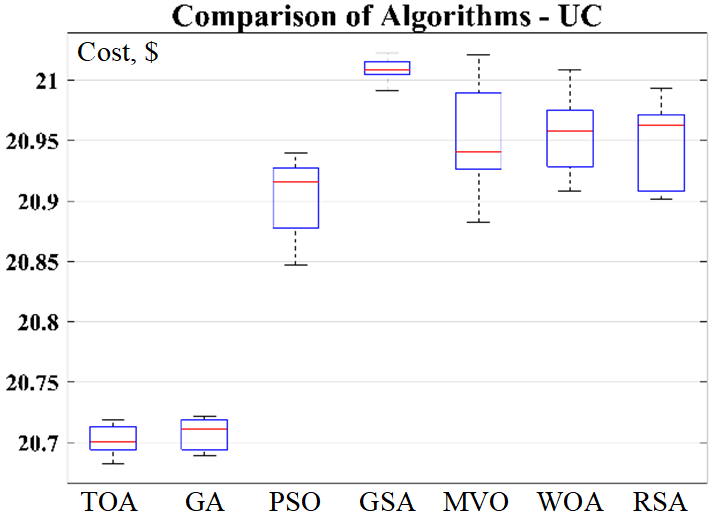
Introduction. The unit commitment (UC) problem is a critical operational task in power systems, involving the optimal scheduling of generating units while meeting demand, satisfying technical constraints, and minimizing operating costs. Due to its combinatorial nature, nonlinear characteristics, and numerous interdependent constraints, UC poses a highly complex optimization challenge. Metaheuristic algorithms have demonstrated strong potential in addressing such large-scale problems; however, many existing methods struggle to maintain a proper exploration–exploitation balance, limiting their performance in dynamic UC environments. Problem. Traditional metaheuristic algorithms often suffer from premature convergence, inadequate local refinement, or dependency on control parameters that require tuning. Such limitations reduce robustness and adaptability when dealing with UC’s intricate search landscape. Therefore, there is a need for a parameter-free, self-adaptive optimization algorithm capable of reliably solving UC with high efficiency and convergence stability. The goal of this study is to develop an efficient and reliable scheduling framework for power generating units in the UC problem by employing the tardigrade optimization algorithm (TOA) and to demonstrate its effectiveness compared with established optimization techniques. Methodology. TOA is inspired by the active and cryptobiotic survival behaviors of tardigrades. The exploration phase imitates active adaptive locomotion to broaden global search, while the exploitation phase abstracts cryptobiotic stability to refine solutions locally. These mechanisms are formulated through adaptive state-transition operators that adjust search behavior automatically without external parameters. TOA is applied to a 24-hour UC problem consisting of 10 generating units under realistic load and operational constraints. Its performance is benchmarked against 6 widely used metaheuristic algorithms. Results. The proposed TOA achieves the lowest total operating cost, exhibits strong convergence behavior, and demonstrates high consistency across independent runs, outperforming all comparative methods. The scientific novelty lies in introducing a biologically inspired, parameter-free, self-adaptive metaheuristic algorithm. Its practical value is validated through superior performance in UC scheduling, indicating strong potential for broader power system optimization tasks. References 21, tables 3, figures 3.
References
Manikandan K., Sasikumar S., Arulraj R. A novelty approach to solve an economic dispatch problem for a renewable integrated micro-grid using optimization techniques. Electrical Engineering & Electromechanics, 2023, no. 4, pp. 83-89. doi: https://doi.org/10.20998/2074-272X.2023.4.12.
Qin J., Yu N. Solve Large-Scale Unit Commitment Problems by Physics-Informed Graph Learning. IEEE Transactions on Power Systems, 2025, vol. 40, no. 6, pp. 4439-4451. doi: https://doi.org/10.1109/TPWRS.2025.3562886.
Greenough R., Murakami K., Davidson M.R., Kleissl J., Khurram A. Wildfire Resilient Unit Commitment Under Uncertain Demand. IEEE Transactions on Power Systems, 2025, vol. 40, no. 4, pp. 3131-3143. doi: https://doi.org/10.1109/TPWRS.2025.3527879.
Ali A., Shah A., Keerio M.U., Mugheri N.H., Abbas G., Touti E., Hatatah M., Yousef A., Bouzguenda M. Multi-Objective Security Constrained Unit Commitment via Hybrid Evolutionary Algorithms. IEEE Access, 2024, vol. 12, pp. 6698-6718. doi: https://doi.org/10.1109/ACCESS.2024.3351710.
Bouhadouza B., Sadaoui F. Optimal power flow analysis under photovoltaic and wind power uncertainties using the blood-sucking leech optimizer. Electrical Engineering & Electromechanics, 2025, no. 6, pp. 15-26. doi: https://doi.org/10.20998/2074-272X.2025.6.03.
Mozhdehi A.T., Khodadadi N., Aboutalebi M., El-Kenawy E.-S.M., Hussien A.G., Zhao W., Nadimi-Shahraki M.H., Mirjalili S. Divine Religions Algorithm: a novel social-inspired metaheuristic algorithm for engineering and continuous optimization problems. Cluster Computing, 2025, vol. 28, no. 4, art. no. 253. doi: https://doi.org/10.1007/s10586-024-04954-x.
Zalzala A.M., Jawad R.K., AL-Salih A.A.M.M., Ahmed M.A., Ibraheem I.K. Application of Spider-Tailed Horned Viper Optimization for Unit Commitment Problem in Power Systems. INASS Express, 2025, vol. 1, no. 1, pp. 10-18. doi: https://doi.org/10.22266/inassexpress.2025.002.
Hamadneh T., Batiha B., Gharib G.M., Aribowo W. Application of Orangutan Optimization Algorithm for Feature Selection Problems. INASS Express, 2025, vol. 1, no. 1, pp. 1-9. doi: https://doi.org/10.22266/inassexpress.2025.001.
Hamadneh T., Batiha B., Gharib G.M. Enhanced Distributed Generation Placement Using Carpet Weaver Optimization: A Comparative Metaheuristic Approach. INASS Express, 2025, vol. 1, no. 1, pp. 19-28. doi: https://doi.org/10.22266/inassexpress.2025.003.
Laouafi F. Improved grey wolf optimizer for optimal reactive power dispatch with integration of wind and solar energy. Electrical Engineering & Electromechanics, 2025, no. 1, pp. 23-30. doi: https://doi.org/10.20998/2074-272X.2025.1.04.
Jeridi A., Moulahi M.H., Khaterchi H., Zaafouri A. Maximum power point tracking improving of photovoltaic systems based on hybrid triangulation topology aggregation optimizer and incremental conductance algorithm. Electrical Engineering & Electromechanics, 2025, no. 5, pp. 17-26. doi: https://doi.org/10.20998/2074-272X.2025.5.03.
Holland J.H. Genetic Algorithms. Scientific American, 1992, vol. 267, no. 1, pp. 66-73.
Kennedy J., Eberhart R. Particle swarm optimization. Proceedings of ICNN’95 – International Conference on Neural Networks, 1995, vol. 4, pp. 1942-1948. doi: https://doi.org/10.1109/ICNN.1995.488968.
Rashedi E., Nezamabadi-pour H., Saryazdi S. GSA: A Gravitational Search Algorithm. Information Sciences, 2009, vol. 179, no. 13, pp. 2232-2248. doi: https://doi.org/10.1016/j.ins.2009.03.004.
Dinler Ö.B., Bektemyssova G., Ahmed M.A., Ibraheem I.K., Smerat A., Montazeri Z., Dehghani M., Malik O.P., Şahin C.B., Al-Salih A.A.M.M., Eguchi K. Blue-eared Hedgehog Optimization (BEHO): A Nature-inspired Metaheuristic for Robust and Efficient Global Optimization. International Journal of Intelligent Engineering and Systems, 2025, vol. 18, no. 11, pp. 133-148. doi: https://doi.org/10.22266/ijies2025.1231.08.
Dinler Ö.B., Bektemyssova G., Şahin C.B., Montazeri Z., Dehghani M., Smerat A., Werner F., Eguchi K. Carpenter Optimization Algorithm: A Human-inspired Metaheuristic for Robust and Efficient Constrained Optimization. International Journal of Intelligent Engineering and Systems, 2025, vol. 18, no. 11, pp. 344-357. doi: https://doi.org/10.22266/ijies2025.1231.21.
Xiao Y., Cui H., Khurma R.A., Castillo P.A. Artificial lemming algorithm: a novel bionic meta-heuristic technique for solving real-world engineering optimization problems. Artificial Intelligence Review, 2025, vol. 58, no. 3, art. no. 84. doi: https://doi.org/10.1007/s10462-024-11023-7.
Wolpert D.H., Macready W.G. No free lunch theorems for optimization. IEEE Transactions on Evolutionary Computation, 1997, vol. 1, no. 1, pp. 67-82. doi: https://doi.org/10.1109/4235.585893.
Mirjalili S., Lewis A. The Whale Optimization Algorithm. Advances in Engineering Software, 2016, vol. 95, pp. 51-67. doi: https://doi.org/10.1016/j.advengsoft.2016.01.008.
Mirjalili S., Mirjalili S.M., Hatamlou A. Multi-Verse Optimizer: a nature-inspired algorithm for global optimization. Neural Computing and Applications, 2016, vol. 27, no. 2, pp. 495-513. doi: https://doi.org/10.1007/s00521-015-1870-7.
Abualigah L., Elaziz M.A., Sumari P., Geem Z.W., Gandomi A.H. Reptile Search Algorithm (RSA): A nature-inspired meta-heuristic optimizer. Expert Systems with Applications, 2022, vol. 191, art. no. 116158. doi: https://doi.org/10.1016/j.eswa.2021.116158.
Downloads
Published
How to Cite
Issue
Section
License
Copyright (c) 2026 S. A. Alomari, A. Smerat, O. P. Malik, M. Dehghani, Z. Montazeri

This work is licensed under a Creative Commons Attribution-NonCommercial 4.0 International License.
Authors who publish with this journal agree to the following terms:
1. Authors retain copyright and grant the journal right of first publication with the work simultaneously licensed under a Creative Commons Attribution License that allows others to share the work with an acknowledgement of the work's authorship and initial publication in this journal.
2. Authors are able to enter into separate, additional contractual arrangements for the non-exclusive distribution of the journal's published version of the work (e.g., post it to an institutional repository or publish it in a book), with an acknowledgement of its initial publication in this journal.
3. Authors are permitted and encouraged to post their work online (e.g., in institutional repositories or on their website) prior to and during the submission process, as it can lead to productive exchanges, as well as earlier and greater citation of published work.