Comparative analysis of numerical, evolutionary and metaheuristic methods for experimental implementation of selective harmonic elimination in a five-level emerging inverter
DOI:
https://doi.org/10.20998/2074-272X.2026.2.08Keywords:
emerging multilevel inverter, genetic algorithm, Newton-Raphson algorithm, particle swarm optimization, selective harmonic eliminationAbstract
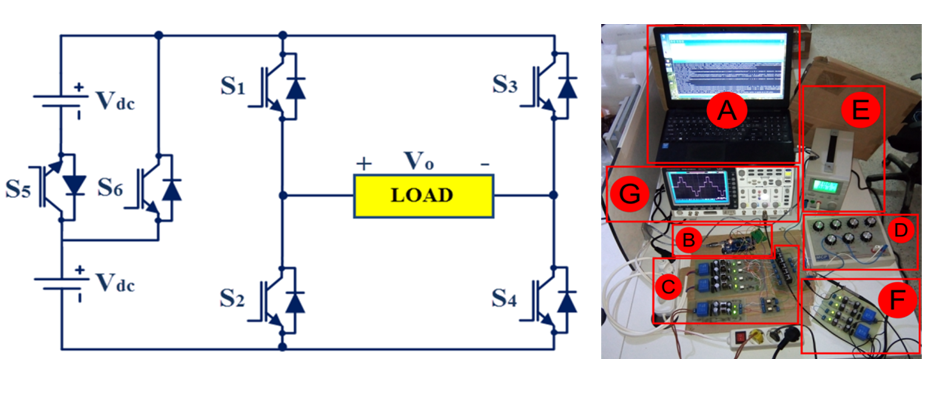
Introduction. Multilevel inverters (MLIs) are widely used in renewable energy conversion and high-performance power applications due to their ability to generate output voltages with low harmonic distortion and reduced switching stress. Selective harmonic elimination (SHE) remains one of the most effective modulation strategies for suppressing low-order harmonics; however, its practical implementation relies on solving nonlinear transcendental equations that often require robust and efficient computational methods. Problem. Determining optimal switching angles for SHE in MLIs remains a challenging optimization problem because of the nonlinear, non-convex nature of the governing equations and the need to simultaneously preserve the fundamental voltage component while eliminating selected harmonics. The choice of an appropriate numerical or optimization-based solution method directly affects computational efficiency, robustness, and practical implementability. The goal of the work is the reducing harmonic distortion of output voltage and determining optimal switching angles of a single-phase 5-level inverter using the Newton-Raphson (NR) method, particle swarm optimization (PSO) and genetic algorithm (GA). Methodology. The operating principle and harmonic model of the inverter are first established using Fourier series analysis. The SHE problem is formulated as a system of nonlinear equations subject to ordering constraints. The NR method is used as a fast numerical solver, while PSO and GA are employed as evolutionary and metaheuristic optimization techniques capable of handling non-convex search spaces. All algorithms are implemented in MATLAB/Simulink over a range of modulation indices. Experimental validation is carried out using an Arduino Mega 2560-based prototype, where the optimized switching patterns are executed in real time and the output voltage is analyzed using oscilloscope and harmonic measurement tools. Results. The three approaches converge to identical switching-angle solutions over the investigated modulation range, confirming the consistency of the formulation. Simulation results demonstrate effective elimination of the 3rd harmonic and its multiples, with the total harmonic distortion of the output voltage decreasing from 28.42 % at M = 0.55, f = 1 kHz to 14.88 % at M = 0.55, f = 10 kHz. In terms of computational efficiency, NR-SHE achieves the shortest execution time (0.516 s), while PSO-SHE (10.237 s) and GA-SHE (23.289 s) require longer computation. Experimental waveforms and harmonic spectra closely match the simulation results, validating the proposed approach. Scientific novelty. This work provides a unified comparative analysis of numerical, evolutionary and metaheuristic methods for SHE applied to a 5-level emerging inverter with a reduced switch count (6 switches instead of 8 in a conventional 5-level H-bridge). In addition, it demonstrates the feasibility of executing SHE-based modulation schemes on a low-cost Arduino microcontroller. Practical value. The presented results offer practical guidance for selecting suitable computational methods for SHE in MLIs and confirm that efficient harmonic control can be achieved using inexpensive embedded platforms. The findings are relevant for research, prototyping and educational applications in industrial electronics and power conversion systems. References 21, tables 5, figures 12.
References
Priyanka G., Surya Kumari J., Lenine D., Srinivasa Varma P., Sneha Madhuri S., Chandu V. MATLAB-Simulink environment based power quality improvement in photovoltaic system using multilevel inverter. Electrical Engineering & Electromechanics, 2023, no. 2, pp. 43-48. doi: https://doi.org/10.20998/2074-272X.2023.2.07.
Aishwarya V. A single-phase reduced switch 21-level asymmetrical multilevel inverter topology for renewable energy systems. Electrical Engineering, 2025, vol. 107, no. 6, pp. 7417-7436. doi: https://doi.org/10.1007/s00202-024-02936-1.
Toubal Maamar A.E., Helaimi M., Taleb R. Analysis, Simulation and Experimental Validation of High Frequency DC/AC Multilevel Inverter. Przegląd Elektrotechniczny, 2020, vol. 1, no. 8, pp. 16-19, https://doi.org/10.15199/48.2020.08.03.
Elamri O., Toubal Maamar A.E., Oukassi A., El Bahir L. Nonlinear Backstepping Controller for Current Control of Grid-Connected Five-Level Inverter. Revista Politécnica, 2024, vol. 54, no. 2, pp. 85-96. doi: https://doi.org/10.33333/rp.vol54n2.08.
Toubal Maamar A.E. Analysis and experimental validation of selective harmonic elimination in single-phase five-level inverter using particle swarm optimization algorithm. Electronics Journal, 2022, vol. 26, no. 2, pp. 65-72. doi: https://doi.org/10.53314/ELS2226065M.
Elamri O., Toubal Maamar A.E., Oukassi A., El Kharki A., Hammoudi A., Mekhilef S. SVPWM-Based Control of a Three-Phase Five-Level NPC Inverter for Grid-Connected Solar Power System. 2025 5th International Conference on Innovative Research in Applied Science, Engineering and Technology (IRASET), 2025, pp. 1-6. doi: https://doi.org/10.1109/IRASET64571.2025.11008300.
Feyrouz Abdelgoui R., Taleb R., Bentaallah A., Chabni F. Harmonic Elimination in Uniform Step Nine-Level Inverter Using Differential Evolution: Experimental Validation. Electronics Journal, 2021, vol. 25, no. 1, pp. 31-36. doi: https://doi.org/10.53314/ELS2125031A.
Parimalasundar E., Muthukaruppasamy S., Dharmaprakash R., Suresh K. Performance investigations of five-level reduced switches count Η-bridge multilevel inverter. Electrical Engineering & Electromechanics, 2023, no. 6, pp. 58-62. doi: https://doi.org/10.20998/2074-272X.2023.6.10.
Mohamed O., Jalil A., Bouazza E.M., Yassine L., Mohamed B. Study and realization of a single-phase solar inverter with harmonics rejection. Advances in Science, Technology & Innovation, 2024, pp. 59-65. doi: https://doi.org/10.1007/978-3-031-51796-9_7.
Toubal Maamar A.E., Helaimi M., Taleb R., Mouloudj H., Elamri O., Gadoum A. Mathematical Analysis of N-R Algorithm for Experimental Implementation of SHEPWM Control on Single-phase Inverter. International Journal of Engineering Trends and Technology, 2020, vol. 68, no. 2, pp. 9-16. doi: https://doi.org/10.14445/22315381/IJETT-V68I2P202.
Hamadneh T., Batiha B., Gharib G.M., Montazeri Z., Dehghani M., Aribowo W., Noori H.M., Jawad R.K., Ibraheem I.K., Eguchi K. Revolution Optimization Algorithm: A New Human-based Metaheuristic Algorithm for Solving Optimization Problems. International Journal of Intelligent Engineering and Systems, 2025, vol. 18, no. 2, pp. 520-531. doi: https://doi.org/10.22266/ijies2025.0331.38.
Ebrahimi F., Wndarko N.A., Gunawan A.I. Wild horse optimization algorithm implementation in 7-level packed U-cell multilevel inverter to mitigate total harmonic distortion. Electrical Engineering & Electromechanics, 2024, no. 5, pp. 34-40. doi: https://doi.org/10.20998/2074-272X.2024.5.05.
Hamadneh T., Batiha B., Gharib G.M., Montazeri Z., Dehghani M., Aribowo W., Zalzala A.M., Jawad R.K., Ahmed M.A., Ibraheem I.K., Eguchi K. Perfumer Optimization Algorithm: A Novel Human-Inspired Metaheuristic for Solving Optimization Tasks. International Journal of Intelligent Engineering and Systems, 2025, vol. 18, no. 4, pp. 633-643. doi: https://doi.org/10.22266/ijies2025.0531.41.
Keek J., Loh S., Wong Y., Woo X., Lee W. Genetic Algorithms and Particle Swarm Optimization for Interference Minimization in Mobile Network Channel Assignment Problem. International Journal of Intelligent Engineering and Systems, 2021, vol. 14, no. 4, pp. 276-288. doi: https://doi.org/10.22266/ijies2021.0831.25.
Subramanian N., Stonier A.A. A Comprehensive Review on Selective Harmonic Elimination Techniques and Its Permissible Standards in Electrical Systems. IEEE Access, 2024, vol. 12, pp. 141966-141998. doi: https://doi.org/10.1109/ACCESS.2024.3436079.
Memon M.A., Siddique M.D., Mekhilef S., Mubin M. Asynchronous Particle Swarm Optimization-Genetic Algorithm (APSO-GA) Based Selective Harmonic Elimination in a Cascaded H-Bridge Multilevel Inverter. IEEE Transactions on Industrial Electronics, 2022, vol. 69, no. 2, pp. 1477-1487. doi: https://doi.org/10.1109/TIE.2021.3060645.
Buccella C., Cecati C., Cimoroni M.G., Kulothungan G., Edpuganti A., Rathore A.K. A Selective Harmonic Elimination Method for Five-Level Converters for Distributed Generation. IEEE Journal of Emerging and Selected Topics in Power Electronics, 2017, vol. 5, no. 2, pp. 775-783. doi: https://doi.org/10.1109/JESTPE.2017.2688726.
Djafer L., Taleb R., Toubal Maamar A.E., Mehedi F., Mostefaoui S.A., Rekmouche H. Analysis and Experimental Implementation of SHEPWM based on Newton-Raphson Algorithm on Three-Phase Inverter using Dspace 1104. 2023 2nd International Conference on Electronics, Energy and Measurement (IC2EM), 2023, pp. 1-6. doi: https://doi.org/10.1109/IC2EM59347.2023.10419389.
Yang X.-S. Genetic Algorithms. Nature-Inspired Optimization Algorithms, 2021, pp. 91-100. doi: https://doi.org/10.1016/B978-0-12-821986-7.00013-5.
Swayamsiddha S. Bio-inspired algorithms: principles, implementation, and applications to wireless communication. Nature-Inspired Computation and Swarm Intelligence, 2020, pp. 49-63. doi: https://doi.org/10.1016/B978-0-12-819714-1.00013-0.
Djafer L., Taleb R., Mehedi F. Dspace implementation of real-time selective harmonics elimination technique using modified carrier on three phase inverter. Electrical Engineering & Electromechanics, 2024, no. 5, pp. 28-33. doi: https://doi.org/10.20998/2074-272X.2024.5.04.
Downloads
Published
How to Cite
Issue
Section
License
Copyright (c) 2026 M. Naidji, A. E. Toubal Maamar, M. Boudour, A. Garmat, A. Aissa-Bokhtache

This work is licensed under a Creative Commons Attribution-NonCommercial 4.0 International License.
Authors who publish with this journal agree to the following terms:
1. Authors retain copyright and grant the journal right of first publication with the work simultaneously licensed under a Creative Commons Attribution License that allows others to share the work with an acknowledgement of the work's authorship and initial publication in this journal.
2. Authors are able to enter into separate, additional contractual arrangements for the non-exclusive distribution of the journal's published version of the work (e.g., post it to an institutional repository or publish it in a book), with an acknowledgement of its initial publication in this journal.
3. Authors are permitted and encouraged to post their work online (e.g., in institutional repositories or on their website) prior to and during the submission process, as it can lead to productive exchanges, as well as earlier and greater citation of published work.