Normal and degraded operation of the open-end winding induction machine fed by 2-level inverters in cascading
DOI:
https://doi.org/10.20998/2074-272X.2026.2.09Keywords:
open-end winding induction machine, cascaded 2-level inverters, degraded mode, power segmentationAbstract
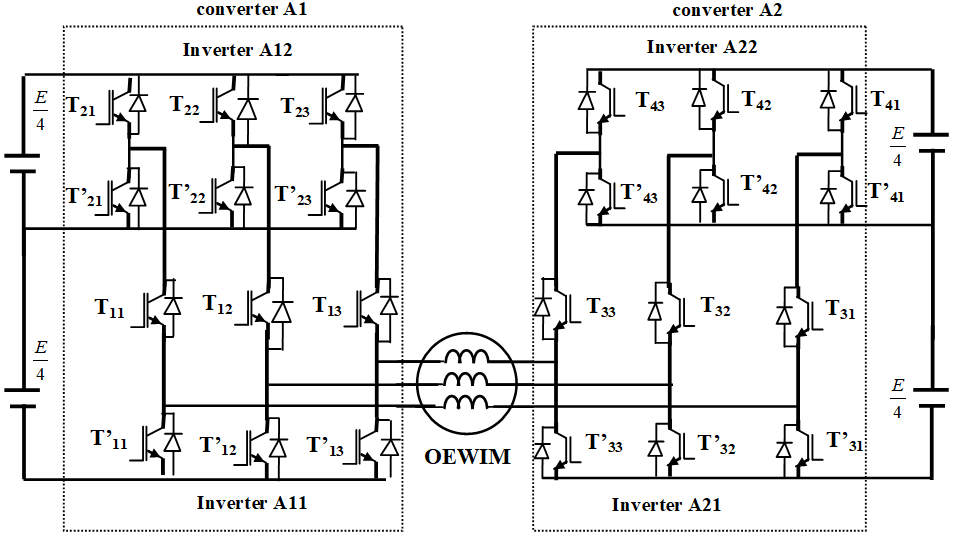
Introduction. The machine-converter system is a prevalent and essential configuration, widely used not only in variable-speed industrial drive applications, but also in high-tech transportation and power fields. Problem. Conventional drive systems, particularly those supplied by standard 2-level inverters, face major challenges regarding the enhancement of their dynamic performance and drive availability. To overcome these limitations, a solution involves utilizing the open-end stator winding induction machine associated with cascaded 2-level inverter topologies. The goal of this work is to improve the availability of the drive system by increasing its degrees of freedom through the association of an open-end winding induction machine by two cascaded 2-level inverters. Methodology. The mathematical modeling of this machine is presented and validated using MATLAB/Simulink. To evaluate the machine’s performance, it is first powered by two cascaded 2-level inverters and subsequently by three cascaded 2-level inverters. Following this initial evaluation, the machine is then fed by two cascaded 2-level inverters operating in degraded mode. This analysis features different failure configurations, and the specific operational conditions that must be respected. Results. This topology enhances dynamic performances and enables effective power segmentation as well as a degraded mode operation. These benefits are confirmed by the simulation results. The scientific novelty is based on demonstrating the effectiveness of degraded mode control, which gives the machine-cascaded inverters topology a superior advantage in terms of reliability and performances. Practical value. This topology provides a highly reliable and fault-tolerant drive solution, ensuring better performance during normal operation and better availability after an inverter failure. References 15, tables 1, figures 24.
References
Nemouchi B., Rezgui S.E., Benalla H., Nebti K. Fractional-based iterative learning-optimal model predictive control of speed induction motor regulation for electric vehicles application. Electrical Engineering & Electromechanics, 2024, no. 5, pp. 14-19. doi: https://doi.org/10.20998/2074-272X.2024.5.02.
Chaib Ras A., Bouzerara R., Bouzeria H. An adaptive controller for power quality control in high speed railway with electric locomotives with asynchronous traction motors. Electrical Engineering & Electromechanics, 2024, no. 2, pp. 23-30. doi: https://doi.org/10.20998/2074-272X.2024.2.04.
Senani F., Rahab A., Benalla H. Performance evaluation and analysis by simulation for sliding mode control with speed regulation of permanent magnet synchronous motor drives in electric vehicles. Electrical Engineering & Electromechanics, 2025, no. 5, pp. 43-48. doi: https://doi.org/10.20998/2074-272X.2025.5.06.
Guizani S., Nayli A., Ben Ammar F. Comparison between star winding and open-end winding induction machines. Electrical Engineering, 2016, vol. 98, no. 3, pp. 219-232. doi: https://doi.org/10.1007/s00202-016-0359-4.
Guizani S., Nayli A., Ben Ammar F. Fault-tolerant control of a double star induction machine operating in active redundancy. Electrical Engineering & Electromechanics, 2025, no. 6, pp. 27-31. doi: https://doi.org/10.20998/2074-272X.2025.6.04.
Nayli A., Guizani S., Ben Ammar F. Experimental analysis for star and open-end stator winding structures of IM. Power Electronics and Drives, 2025, vol. 10, no. 1, pp. 271-286. doi: https://doi.org/10.2478/pead-2025-0019.
Ebrahimi F., Wndarko N.A., Gunawan A.I. Wild horse optimization algorithm implementation in 7-level packed U-cell multilevel inverter to mitigate total harmonic distortion. Electrical Engineering & Electromechanics, 2024, no. 5, pp. 34-40. doi: https://doi.org/10.20998/2074-272X.2024.5.05.
Benboukous M., Bahri H., Talea M., Bour M., Abdouni K. Comparative analysis of principal modulation techniques for modular multilevel converter and a modified reduced switching frequency algorithm for nearest level pulse width modulation. Electrical Engineering & Electromechanics, 2025, no. 4, pp. 26-34. doi: https://doi.org/10.20998/2074-272X.2025.4.04.
Sun J., Zheng Z., Li C., Wang K., Li Y. Optimal Fault-Tolerant Control of Multiphase Drives Under Open-Phase/Open-Switch Faults Based on DC Current Injection. IEEE Transactions on Power Electronics, 2022, vol. 37, no. 5, pp. 5928-5936. doi: https://doi.org/10.1109/TPEL.2021.3135280.
Abdelwanis M.I., Zaky A.A. Maximum power point tracking in a perovskite solar pumping system with a six-phase induction motor. Revue Roumaine des Sciences Techniques Serie Electrotechnique et Energetique, 2024, vol. 69, no. 1, pp. 15-20. doi: https://doi.org/10.59277/RRST-EE.2024.1.3.
Chaabane H., Khodja D.E., Chakroune S., Hadji D. Model reference adaptive backstepping control of double star induction machine with extended Kalman sensorless control. Electrical Engineering & Electromechanics, 2022, no. 4, pp. 3-11. doi: https://doi.org/10.20998/2074-272X.2022.4.01.
L’Hadj Said M., Ali Moussa M., Bessaad T. Control of an autonomous wind energy conversion system based on doubly fed induction generator supplying a non-linear load. Electrical Engineering & Electromechanics, 2025, no. 4, pp. 3-10. doi: https://doi.org/10.20998/2074-272X.2025.4.01.
Darsouni Z., Rezgui S.E., Benalla H., Rebahi F., Boumendjel M.A.M. Ensuring service continuity in electric vehicles with vector control and linear quadratic regulator for dual star induction motors. Electrical Engineering & Electromechanics, 2025, no. 2, pp. 24-30. doi: https://doi.org/10.20998/2074-272X.2025.2.04.
Zerdani M., Ardjoun S.A.E.M., Chafouk H., Denai M. Experimental Investigation of Decoupled Discontinuous PWM Strategies in Open-End Winding Induction Motor Supplied by a Common DC-Link. IEEE Journal of Emerging and Selected Topics in Power Electronics, 2023, vol. 11, no. 3, pp. 3087-3096. doi: https://doi.org/10.1109/JESTPE.2023.3258799.
Yu Z., Chen Y., Zhao J., Zhang X., Zhou X. Alternate Subhexagonal Center Dual-Inverter PWM Scheme for Open-End Winding DC-Biased-VRM Drive Using Adjustable Zero Voltage Vector With Dead-Time Effect Compensation. IEEE Transactions on Transportation Electrification, 2025, vol. 11, no. 3, pp. 7322-7333. doi: https://doi.org/10.1109/TTE.2025.3526609.
Downloads
Published
How to Cite
Issue
Section
License
Copyright (c) 2026 A. Nayli, S. Guizani, F. Ben Ammar

This work is licensed under a Creative Commons Attribution-NonCommercial 4.0 International License.
Authors who publish with this journal agree to the following terms:
1. Authors retain copyright and grant the journal right of first publication with the work simultaneously licensed under a Creative Commons Attribution License that allows others to share the work with an acknowledgement of the work's authorship and initial publication in this journal.
2. Authors are able to enter into separate, additional contractual arrangements for the non-exclusive distribution of the journal's published version of the work (e.g., post it to an institutional repository or publish it in a book), with an acknowledgement of its initial publication in this journal.
3. Authors are permitted and encouraged to post their work online (e.g., in institutional repositories or on their website) prior to and during the submission process, as it can lead to productive exchanges, as well as earlier and greater citation of published work.