An integrated series active power filter combined with a PV-battery system based on a fuzzy logic controller to enhance power quality for various linear and non-linear loads
DOI:
https://doi.org/10.20998/2074-272X.2026.1.07Keywords:
power quality, series active power filter, PV-battery system, fuzzy logic control, voltage disturbances, harmonic mitigation, linear and nonlinear loadsAbstract
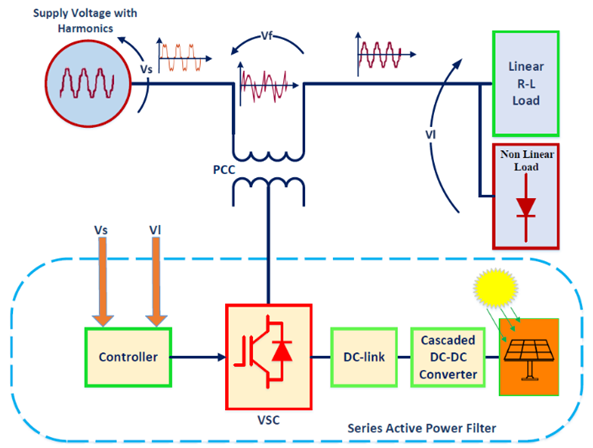
Introduction. Rapid capacity development and the incorporation of new loads are adding complexity to the distribution power system. As a result, the distribution system faces additional power quality issues, particularly with increasingly sensitive equipment and distributed generation. Problem. Modern power systems face escalating power quality degradation due to non-linear loads. Voltage disturbances (sags, swells) and harmonic distortions directly affect the sensitive equipment, causing significant economic losses. The goal of this work is to design, model, and evaluate series active power filters (SAPFs) integrated with energy management for an independent solar storage system, using a multi-stage DC-DC converter. The objective focuses on mitigating voltage harmonics and grid disturbances resulting from diverse loads (linear, non-linear, and combined) and integrating renewable energy (PV). Control is achieved through an intelligent fuzzy logic controller (FLC) and a PI controller to ensure a stable DC voltage and reduce the total harmonic distortion (THD) of the voltage to less than 5 %. Methodology. This study models and analyzes a unique SAPF configuration integrated with a PV-battery storage system utilizing MATLAB/Simulink. Outcomes of the proposed control, wherever the FLC regulates the DC-link voltage reference signals utilize the instantaneous reactive power theory. The suggested methodology entails simulation studies across four scenarios: an analysis of performance to keep voltage components and a comparison of the proposed SAPF performance with existing research on linear, non-linear, and combined loads. Results. Simulation results show the effectiveness of the control approach in mitigating the voltage THD level to less than 5 % under various operating conditions that included the main supply voltage and loads, which satisfies the international PQ standards (IEEE Std. 519). The scientific novelty lies in the combination of a new 3-phase SAPF with a PV-battery system by FLC and a cascaded DC/DC converter. This allows effective voltage disturbance and harmonic compensation in various load situations without conventional transformers. Practical value. This research offers a robust solution for power quality problems in modern grids, reducing losses by ensuring stable, no-distortion power for sensitive industrial loads across varied operating conditions. References 46, tables 3, figures 19.
References
Salleh Z.M.T., Alsammak A.N.B., Mohammed H.A. Enhancing Power System Transient Stability Using Static Var Compensator Based on a Fuzzy Logic Controller. Journal Européen Des Systèmes Automatisés, 2024, vol. 57, no. 6, pp. 1565-1572. doi: https://doi.org/10.18280/jesa.570603.
Chaudhari M.A., Chandraprakash. Three-phase Series Active Power Filter as Power Quality Conditioner. 2012 IEEE International Conference on Power Electronics, Drives and Energy Systems (PEDES), 2012, pp. 1-6. doi: https://doi.org/10.1109/PEDES.2012.6484387.
Zorig A., Babes B., Hamouda N., Mouassa S. Improving the efficiency of a non-ideal grid coupled to a photovoltaic system with a shunt active power filter using a self-tuning filter and a predictive current controller. Electrical Engineering & Electromechanics, 2024, no. 6, pp. 33-43. doi: https://doi.org/10.20998/2074-272X.2024.6.05.
Qasim A.Y., Tahir F.R., Alsammak A.N.B. Improving Power Quality in Distribution Systems Using UPQC: An Overview. Journal Européen Des Systèmes Automatisés, 2024, vol. 57, no. 2, pp. 311-322. doi: https://doi.org/10.18280/jesa.570201.
Manohara M., Muthukaruppasamy S., Dharmaprakash R., Sendilkumar S., Dattatreya Bharadwaj D., Parimalasundar E. Power quality enhancement of grid-integrated solar photovoltaic system with unified power quality conditioner. Electrical Engineering & Electromechanics, 2024, no. 6, pp. 44-48. doi: https://doi.org/10.20998/2074-272X.2024.6.06.
Qasim A.Y., Tahir F.R., Alsammak A.N.B. Utilizing UPQC-Based PAC-SRF Techniques to Mitigate Power Quality Issues under Non-Linear and Unbalanced Loads. Journal Européen Des Systèmes Automatisés, 2023, vol. 56, no. 5, pp. 823-831. doi: https://doi.org/10.18280/jesa.560513.
Kalyan K., Rao M.S., Gawre S. Improvement of Power Quality Using Series Active Power Filter (SAPF). 2020 IEEE International Students’ Conference on Electrical, Electronics and Computer Science (SCEECS), 2020, pp. 1-5. doi: https://doi.org/10.1109/SCEECS48394.2020.151.
Kim Y.S., Kim J.S., Ko S.H. Three-phase three-wire series active power filter, which compensates for harmonics and reactive power. IEE Proceedings - Electric Power Applications, 2004, vol. 151, no. 3, pp. 276-282. doi: https://doi.org/10.1049/ip-epa:20040208.
Muthukaruppasamy S., Dharmaprakash R., Sendilkumar S., Parimalasundar E. Enhancing off-grid wind energy systems with controlled inverter integration for improved power quality. Electrical Engineering & Electromechanics, 2024, no. 5, pp. 41-47. https://doi.org/10.20998/2074-272X.2024.5.06.
Benazza B., Ouadi H. Backstepping Control of Three-Phase Multilevel Series Active Power Filter. 2020 International Conference on Electrical and Information Technologies (ICEIT), 2020, pp. 1-6. doi: https://doi.org/10.1109/ICEIT48248.2020.9113178.
Bousnoubra C., Djeghader Y., Belila H. Contribution of using a photovoltaic unified power quality conditioner in power quality improvement. Electrical Engineering & Electromechanics, 2024, no. 4, pp. 42-47. doi: https://doi.org/10.20998/2074-272X.2024.4.05.
Venkatraman K., Selvan M.P., Moorthi S. Performance of Series Active Filter in low voltage distribution system with non linear loads. 2011 Annual IEEE India Conference, 2011, pp. 1-6. doi: https://doi.org/10.1109/INDCON.2011.6139548.
Mekri F., Machmoum M., Aït-Ahmed N., Mazari B. A comparative study of voltage controllers for series active power filter. Electric Power Systems Research, 2010, vol. 80, no. 6, pp. 615-626. doi: https://doi.org/10.1016/j.epsr.2009.10.025.
Pazhanimuthu C., Ramesh S. Grid integration of renewable energy sources (RES) for power quality improvement using adaptive fuzzy logic controller based series hybrid active power filter (SHAPF). Journal of Intelligent & Fuzzy Systems, 2018, vol. 35, no. 1, pp. 749-766. doi: https://doi.org/10.3233/JIFS-171236.
Das S.R., Ray P.K., Mohanty A. Fuzzy Sliding Mode Based Series Hybrid Active Power Filter for Power Quality Enhancement. Advances in Fuzzy Systems, 2018, pp. 1-8. doi: https://doi.org/10.1155/2018/1309518.
Nakade V., Patil S. Implementation of Power Quality Enhancement using Hybrid Series Active Filter. 2019 International Conference on Communication and Electronics Systems (ICCES), pp. 238-241. doi: https://doi.org/10.1109/ICCES45898.2019.9002378.
Toumi T., Allali A., Meftouhi A., Abdelkhalek O., Benabdelkader A., Denai M. Robust control of series active power filters for power quality enhancement in distribution grids: Simulation and experimental validation. ISA Transactions, 2020, vol. 107, pp. 350-359. doi: https://doi.org/10.1016/j.isatra.2020.07.024.
Mishra K.K., Gupta R. Impedance Factor based Control Strategy for Series Active Power Filter in Distribution System. IECON 2020 The 46th Annual Conference of the IEEE Industrial Electronics Society, pp. 2987-2992. doi: https://doi.org/10.1109/IECON43393.2020.9255093.
Pazhanimuthu C., Baranilingesan I., Karthick A. An improved control algorithm for Series Hybrid Active Power Filter based on SOGI-PLL under dynamic load conditions. Solid State Communications, 2021, vol. 333, art. no. 114357. doi: https://doi.org/10.1016/j.ssc.2021.114357.
Cholamuthu P., Irusappan B., Paramasivam S.K., Ramu S.K., Muthusamy S., Panchal H., Nuvvula R.S.S., Kumar P.P., Khan B. A Grid-Connected Solar PV/Wind Turbine Based Hybrid Energy System Using ANFIS Controller for Hybrid Series Active Power Filter to Improve the Power Quality. International Transactions on Electrical Energy Systems, 2022, pp. 1-14. doi: https://doi.org/10.1155/2022/9374638.
Rustemli S., Satici M.A., Şahin G., Van Sark W. Investigation of harmonics analysis power system due to non-linear loads on the electrical energy quality results. Energy Reports, 2023, vol. 10, pp. 4704-4732. doi: https://doi.org/10.1016/j.egyr.2023.11.034.
Sathish Babu P., Balasundar C., Sundarabalan C.K. ANFIS controlled fuel cell powered series active filter for voltage waveform augmentation in the distribution grid. E-Prime - Advances in Electrical Engineering, Electronics and Energy, 2024, vol. 7, art. no. 100425. doi: https://doi.org/10.1016/j.prime.2024.100425.
Rafiq Nazer M.N., Noorwali A., Tajuddin M.F.N., Khan M.Z., Ahmad Tazally M.A.I., Ahmed J., Babu T.S., Ghazali N.H., Chakraborty C., Manoj Kumar N. Scenario-Based Investigation on the Effect of Partial Shading Condition Patterns for Different Static Solar Photovoltaic Array Configurations. IEEE Access, 2021, vol. 9, pp. 116050-116072. doi: https://doi.org/10.1109/ACCESS.2021.3105045.
Zhuang Y., Liu F., Huang Y., Zhang X., Zha X. A Voltage-Balancer-Based Cascaded DC–DC Converter With a Novel Power Feedforward Control for the Medium-Voltage DC Grid Interface of Photovoltaic Systems. IEEE Access, 2019, vol. 7, pp. 178094-178107. doi: https://doi.org/10.1109/ACCESS.2019.2959040.
Aravind S., Vinatha U., Jayasankar V.N. Wind-solar grid connected renewable energy system with series active self tuning filter. 2016 International Conference on Electrical, Electronics, and Optimization Techniques (ICEEOT), pp. 1944-1948. doi: https://doi.org/10.1109/ICEEOT.2016.7755028.
Meftouhi A., Abdelkhalek O., Allali A., Abdelkader A.B., Toumi T. PV integrated series active filter for sag voltage and harmonic compensation. International Journal of Power Electronics and Drive Systems, 2019, vol. 10, no. 3, pp. 1255-1262. doi: https://doi.org/10.11591/ijpeds.v10.i3.pp1255-1262.
Guergah M., Nebti K., Rezgui S.E., Benalla H., Ould-Abdeslam D. Power quality enhancement using active power filter five-level cascade H-bridge under unbalanced and distorted grid. Electrical Engineering & Electromechanics, 2023, no. 1, pp. 20-24. doi: https://doi.org/10.20998/2074-272X.2023.1.03.
Salmerón Revuelta P., Pérez Litrán S., Prieto Thomas J. Combined Shunt and Series Active Power Filters. Active Power Line Conditioners, 2016, pp. 231-284. doi: https://doi.org/10.1016/B978-0-12-803216-9.00007-9.
El Ghaly A., Tarnini M., Al Barakeh Z., Chahine K. Compensating voltage waveform distortions using a practical topology of series active power filters. Results in Engineering, 2024, vol. 22, art. no. 102032. doi: https://doi.org/10.1016/j.rineng.2024.102032.
Nguyen D., Lehman B. An Adaptive Solar Photovoltaic Array Using Model-Based Reconfiguration Algorithm. IEEE Transactions on Industrial Electronics, 2008, vol. 55, no. 7, pp. 2644-2654. doi: https://doi.org/10.1109/TIE.2008.924169.
Mimouni A., Laribi S., Sebaa M., Allaoui T., Bengharbi A.A. Fault diagnosis of power converters in a grid connected photovoltaic system using artificial neural networks. Electrical Engineering & Electromechanics, 2023, no. 1, pp. 25-30. doi: https://doi.org/10.20998/2074-272X.2023.1.04.
Mishra S., Ziar H., Isabella O., Zeman M. Selection Map for PV Module Installation Based on Shading Tolerability and Temperature Coefficient. IEEE Journal of Photovoltaics, 2019, vol. 9, no. 3, pp. 872-880. doi: https://doi.org/10.1109/JPHOTOV.2019.2900695.
Chaib H., Hassaine S., Mihoub Y., Moreau S. Intelligent power control strategy based on self-tuning fuzzy MPPT for grid-connected hybrid system. Electrical Engineering & Electromechanics, 2025, no. 3, pp. 23-30. doi: https://doi.org/10.20998/2074-272X.2025.3.04.
Hessad M.A., Bouchama Z., Benaggoune S., Behih K. Cascade sliding mode maximum power point tracking controller for photovoltaic systems. Electrical Engineering & Electromechanics, 2023, no. 1, pp. 51-56. doi: https://doi.org/10.20998/2074-272X.2023.1.07.
Shahir F.M., Aberoumandazar M., Babaei E. High Gain DC-DC Boost Converter Applied in Hybrid System of Photovoltaic and Battery. 2021 International Symposium on Devices, Circuits and Systems (ISDCS), 2021, pp. 1-4. doi: https://doi.org/10.1109/ISDCS52006.2021.9397922.
Surya P.P., Irawan D., Zuhri M. Review and comparison Of DC-DC converters for maximum power point tracking system in standalone photovoltaic (PV) module. 2017 International Conference on Advanced Mechatronics, Intelligent Manufacture, and Industrial Automation (ICAMIMIA), 2017, pp. 242-247. doi: https://doi.org/10.1109/ICAMIMIA.2017.8387595.
Latreche K., Taleb R., Bentaallah A., Toubal Maamar A.E., Helaimi M., Chabni F. Design and experimental implementation of voltage control scheme using the coefficient diagram method based PID controller for two-level boost converter with photovoltaic system. Electrical Engineering & Electromechanics, 2024, no. 1, pp. 3-9. doi: https://doi.org/10.20998/2074-272X.2024.1.01.
Farswan R.S., Datta A., Kamble G., Fernandes B.G. A low leakage transformer-less 3-level DC-DC boost converter for transformer-less PV inverters. 2015 17th European Conference on Power Electronics and Applications (EPE’15 ECCE-Europe), 2015, pp. 1-10. doi: https://doi.org/10.1109/EPE.2015.7309321.
Bonfiglio A., Brignone M., Delfino F., Procopio R. Optimal Control and Operation of Grid-Connected Photovoltaic Production Units for Voltage Support in Medium-Voltage Networks. IEEE Transactions on Sustainable Energy, 2014, vol. 5, no. 1, pp. 254-263. doi: https://doi.org/10.1109/TSTE.2013.2280811.
Yang T., Mok K.-T., Ho S.-S., Tan S.-C., Lee C.-K., Hui R.S.Y. Use of Integrated Photovoltaic-Electric Spring System as a Power Balancer in Power Distribution Networks. IEEE Transactions on Power Electronics, 2019, vol. 34, no. 6, pp. 5312-5324. doi: https://doi.org/10.1109/TPEL.2018.2867573.
Parimalasundar E., Kumar N.M.G., Geetha P., Suresh K. Performance investigation of modular multilevel inverter topologies for photovoltaic applications with minimal switches. Electrical Engineering & Electromechanics, 2022, no. 6, pp. 28-34. doi: https://doi.org/10.20998/2074-272X.2022.6.05.
Huang X., Wang H., Guo L., Ju C., Liu R., Meng S., Wang Y., Xu H. Large-scale photovoltaic generation system connected to HVDC grid with centralized high voltage and high power DC/DC converter. 2017 20th International Conference on Electrical Machines and Systems (ICEMS), 2017, pp. 1-6. doi: https://doi.org/10.1109/ICEMS.2017.8056289.
Ayat Y., Badoud A.E., Mekhilef S., Gassab S. Energy management based on a fuzzy controller of a photovoltaic/fuel cell/Li-ion battery/supercapacitor for unpredictable, fluctuating, high-dynamic three-phase AC load. Electrical Engineering & Electromechanics, 2023, no. 3, pp. 66-75. doi: https://doi.org/10.20998/2074-272X.2023.3.10.
Adiche S., Larbi M., Toumi D. Optimizing voltage control in AC microgrid systems with fuzzy logic strategies and performance assessment. Electrical Engineering & Electromechanics, 2025, no. 3, pp. 11-17. doi: https://doi.org/10.20998/2074-272X.2025.3.02.
Mohammed H.A., Alsammak A.N.B. An Intelligent Hybrid Control System using ANFIS-Optimization for Scalar Control of an Induction Motor. Journal Européen Des Systèmes Automatisés, 2023, vol. 56, no. 5, pp. 857-862. doi: https://doi.org/10.18280/jesa.560516.
Zerzouri N., Ben Si Ali N., Benalia N. A maximum power point tracking of a photovoltaic system connected to a three-phase grid using a variable step size perturb and observe algorithm. Electrical Engineering & Electromechanics, 2023, no. 5, pp. 37-46. doi: https://doi.org/10.20998/2074-272X.2023.5.06.
Downloads
Published
How to Cite
Issue
Section
License
Copyright (c) 2025 B. M. Anwer, A. N. Alsammak

This work is licensed under a Creative Commons Attribution-NonCommercial 4.0 International License.
Authors who publish with this journal agree to the following terms:
1. Authors retain copyright and grant the journal right of first publication with the work simultaneously licensed under a Creative Commons Attribution License that allows others to share the work with an acknowledgement of the work's authorship and initial publication in this journal.
2. Authors are able to enter into separate, additional contractual arrangements for the non-exclusive distribution of the journal's published version of the work (e.g., post it to an institutional repository or publish it in a book), with an acknowledgement of its initial publication in this journal.
3. Authors are permitted and encouraged to post their work online (e.g., in institutional repositories or on their website) prior to and during the submission process, as it can lead to productive exchanges, as well as earlier and greater citation of published work.