Comparative performance analysis of backstepping and sliding mode control for static synchronous compensators based on flying capacitor multicell converters
DOI:
https://doi.org/10.20998/2074-272X.2026.2.04Keywords:
flying capacitor multicell converter, static synchronous compensator, sliding mode control, PI controllerAbstract
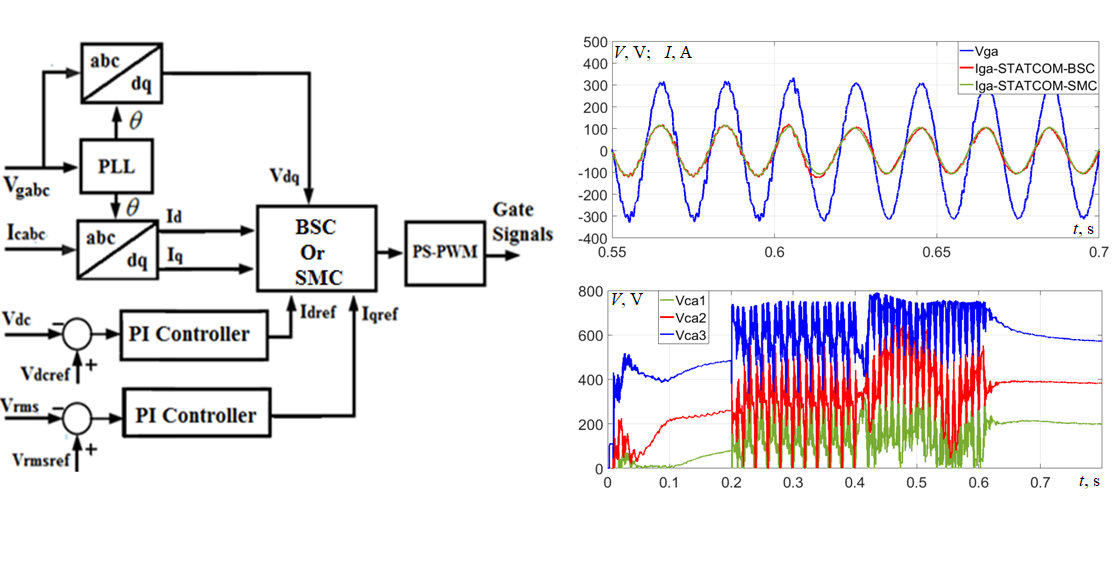
Introduction. The integration of a static synchronous compensator (STATCOM) based on a flying capacitor multicell converter (FCMC) provides an effective solution for dynamic reactive power compensation and voltage quality improvement. The adoption of nonlinear control strategies, such as sliding mode control (SMC) and backstepping (BSC), enhances system robustness and ensures precise tracking of variables despite network nonlinearities and disturbances. Problem. Reactive, inductive or capacitive loads cause network imbalances leading to voltage sags, swells and fluctuations at the point of common coupling (PCC). These disturbances degrade power quality, reduce the power factor and place excessive stress on equipment. Moreover, high reactive power flow increases losses and decreases the overall system efficiency. Goal. This study compares the performance of SMC and BSC controllers applied to a STATCOM for PCC voltage regulation aiming to improve the power factor, effectively control reactive power and overcome the limitations of conventional controllers under network nonlinearities and voltage disturbances caused by reactive loads. Methodology. The SMC uses a sliding surface based on current errors to achieve fast and precise tracking even in the presence of disturbances. The BSC control employs Lyapunov functions to decompose the nonlinear system into controllable subsystems, ensuring overall stability. Both strategies are simulated on a 5-level flying capacitor multicell STATCOM using MATLAB/Simulink. Simulation results confirm the effectiveness of both controllers in maintaining the PCC voltage at its reference value with a very short response time (1 ms), even under reactive load variations. Precise reactive power control enables rapid compensation of fluctuations, improves the power factor and reduces harmonic distortion. The scientific novelty of this work lies in the comparative performance analysis of the nonlinear SMC and BSC controllers applied to a STATCOM based on a FCMC converter, considering network disturbances caused by reactive loads. Practical value. These nonlinear control strategies significantly enhance the stability, voltage quality, and power factor of low-voltage networks equipped with STATCOMs. References 36, tables 4, figures 18.
References
Asoodar M., Nahalparvari M., Zhang Y., Danielsson C., Nee H.-P., Blaabjerg F. Accurate Condition Monitoring of Semiconductor Devices in Cascaded H-Bridge Modular Multilevel Converters. IEEE Transactions on Power Electronics, 2023, vol. 38, no. 3, pp. 3870-3884. doi: https://doi.org/10.1109/TPEL.2022.3221285.
Carbonara A., Dambone Sessa S., L’Abbate A., Sanniti F., Chiumeo R. Comparison of Advanced Flexible Alternating Current Transmission System (FACTS) Devices with Conventional Technologies for Power System Stability Enhancement: An Updated Review. Electronics, 2024, vol. 13, no. 21, art. no. 4262. doi: https://doi.org/10.3390/electronics13214262.
Pires V.F., Cordeiro A., Foito D., Silva J.F. A Multilevel Converter Topology for a STATCOM System Based on Four-Leg Two-Level Inverters and Cascaded Scott Transformers. IEEE Transactions on Power Delivery, 2022, vol. 37, no. 3, pp. 1391-1402. doi: https://doi.org/10.1109/TPWRD.2021.3086399.
Sharma S., Gupta S., Zuhaib M., Bhuria V., Malik H., Almutairi A., Afthanorhan A., Hossaini M.A. A Comprehensive Review on STATCOM: Paradigm of Modeling, Control, Stability, Optimal Location, Integration, Application, and Installation. IEEE Access, 2024, vol. 12, pp. 2701-2729. doi: https://doi.org/10.1109/ACCESS.2023.3345216.
He C., Yang B., Luo Z., Liu G. Research on a New Topology and Reactive Power Compensation Application of Reinjection Multilevel Voltage Source Converter. Applied Sciences, 2024, vol. 14, no. 21, art. no. 9998. doi: https://doi.org/10.3390/app14219998.
Sharma H., Nanda H., Yadav A. Novel nine level switched capacitor multi-level inverter based STATCOM for distribution system. Computers and Electrical Engineering, 2024, vol. 120, art. no. 109647. doi: https://doi.org/10.1016/j.compeleceng.2024.109647.
Atanalian S., Sebaaly F., Zgheib R., Al-Haddad K. Z Packed U-Cell Modular Multilevel Converter for STATCOM Applications. IEEE Access, 2025, vol. 13, pp. 78795-78807. doi: https://doi.org/10.1109/ACCESS.2025.3566015.
Heidari M., Kovsarian A., Seifossadat S.Gh. Power quality improvement with cascaded multilevel converter based STATCOM. IIUM Engineering Journal, 2018, vol. 19, no. 1, pp. 91-103. doi: https://doi.org/10.31436/iiumej.v19i1.873.
Hassan R.F., Shyaa S.S. Design and Analysis of the STATCOM Based on Diode Clamped Multilevel Converter Using Model Predictive Current Control Strategy. European Journal of Electrical Engineering, 2021, vol. 23, no. 3, pp. 221-228. doi: https://doi.org/10.18280/ejee.230306.
Neyshabouri Y., Chaudhary S.K., Teodorescu R., Sajadi R., Iman-Eini H. Improving the Reactive Current Compensation Capability of Cascaded H-Bridge Based STATCOM Under Unbalanced Grid Voltage. IEEE Journal of Emerging and Selected Topics in Power Electronics, 2020, vol. 8, no. 2, pp. 1466-1476. doi: https://doi.org/10.1109/JESTPE.2019.2916571.
Hasanzadeh S., Shojaeian H., Mohsenzadeh M.M., Heydarian-Forushani E., Alhelou H.H., Siano P. Power Quality Enhancement of the Distribution Network by Multilevel STATCOM-Compensated Based on Improved One-Cycle Controller. IEEE Access, 2022, vol. 10, pp. 50578-50588. doi: https://doi.org/10.1109/ACCESS.2022.3172144.
Cheng Q., Wang C., Chen Z. A Dual Modulation Waveform PWM Combined With Phase-Shifted Carriers in Stacked Multicell Converter. IEEE Transactions on Power Electronics, 2021, vol. 36, no. 12, pp. 14456-14465. doi: https://doi.org/10.1109/TPEL.2021.3088463.
Tebaldi D. An Approach to Control Multilevel Flying-Capacitor Converters Using Optimal Dynamic Programming Benchmark. Electronics, 2025, vol. 14, no. 5, art. no. 948. doi: https://doi.org/10.3390/electronics14050948.
Mersche S.C., Schwendemann R., Hiller M. Validation of the Quasi-Two-Level Operation for a Flying Capacitor Converter in Medium-Voltage Applications. Energies, 2023, vol. 16, no. 6, art. no. 2797. doi: https://doi.org/10.3390/en16062797.
Ebrahimi J., Esfahani F.N., Eren S., Bakhshai A. An Active Capacitor Voltage Balancing Method for a Four-Level Single Flying Capacitor Converter. IECON 2024 - 50th Annual Conference of the IEEE Industrial Electronics Society, 2024, pp. 1-6. doi: https://doi.org/10.1109/IECON55916.2024.10905229.
Laamiri S., Ghanes M., Santomenna G. Observer based direct control strategy for a multi-level three phase flying-capacitor inverter. Control Engineering Practice, 2019, vol. 86, pp. 155-165. doi: https://doi.org/10.1016/j.conengprac.2019.03.011.
Redouane A., Saou R., Oukaour A. Flying Capacitor Voltage Balancing Control Strategy Based on Logic-equations in Five Level ANPC Inverter. Periodica Polytechnica Electrical Engineering and Computer Science, 2023, vol. 67, no. 4, pp. 438-448. doi: https://doi.org/10.3311/PPee.21879.
Buso S., Rossetto L. Damping of Flying Capacitor Dynamics in Multi-Level Boost DC-DC Converters. Electronics, 2024, vol. 13, no. 24, art. no. 4883. doi: https://doi.org/10.3390/electronics13244883.
Ramakrishna E., Gadhamappagari J., Sujatha P. Auto tuning of PI Gains using Cuttlefish Optimization for DC Link Voltage Control in a 5-level HB MMC D-STATCOM. Engineering, Technology & Applied Science Research, 2023, vol. 13, no. 6, pp. 12086-12091. doi: https://doi.org/10.48084/etasr.6413.
Stepanov A., Saad H., Mahseredjian J. Modeling of MMC-based STATCOM with embedded energy storage for the simulation of electromagnetic transients. Electric Power Systems Research, 2023, vol. 220, art. no. 109316. doi: https://doi.org/10.1016/j.epsr.2023.109316.
Yu L., Wang G., Wu T., Zhu J., Booth C.D. Variable DC voltage based reactive power enhancement scheme for MMC‐STATCOM. IET Smart Grid, 2024, vol. 7, no. 4, pp. 427-441. doi: https://doi.org/10.1049/stg2.12147.
Ahmed T., Waqar A., Elavarasan R.M., Imtiaz J., Premkumar M., Subramaniam U. Analysis of Fractional Order Sliding Mode Control in a D-STATCOM Integrated Power Distribution System. IEEE Access, 2021, vol. 9, pp. 70337-70352. doi: https://doi.org/10.1109/ACCESS.2021.3078608.
Boghdady T.A., Mohamed Y.A. Reactive power compensation using STATCOM in a PV grid connected system with a modified MPPT method. Ain Shams Engineering Journal, 2023, vol. 14, no. 8, art. no. 102060. doi: https://doi.org/10.1016/j.asej.2022.102060.
Freire D.F.M., Caseiro L.M.A., Mendes A.M.S. Model Predictive Control of a five-level Neutral-Point-Clamped STATCOM. 2019 IEEE International Conference on Industrial Technology (ICIT), 2019, pp. 1482-1487. doi: https://doi.org/10.1109/ICIT.2019.8755208.
Jin Y., Xiao Q., Jia H., Mu Y., Ji Y., Teodorescu R., Dragicevic T. A Dual-Layer Back-Stepping Control Method for Lyapunov Stability in Modular Multilevel Converter Based STATCOM. IEEE Transactions on Industrial Electronics, 2022, vol. 69, no. 3, pp. 2166-2179. doi: https://doi.org/10.1109/TIE.2021.3063973.
Djellad A., Belakehal S., Chenni R., Dekhane A. Reliability Improvement in Serial Multicellular Converters Based on STATCOM Control. Journal Europeen des Systemes Automatises, 2021, vol. 54, no. 4, pp. 519-528. doi: https://doi.org/10.18280/jesa.540401.
Bressan M.V., Rech C., Batschauer A.L. Design of flying capacitors for n-level FC and n-level SMC. International Journal of Electrical Power & Energy Systems, 2019, vol. 113, pp. 220-228. doi: https://doi.org/10.1016/j.ijepes.2019.05.030.
El Khlifi Y., El Magri A., Lajouad R., Bouattane O., Giri F. Output-feedback control of a grid-connected photovoltaic system based on a multilevel flying-capacitor inverter with power smoothing capability. ISA Transactions, 2024, vol. 147, pp. 360-381. doi: https://doi.org/10.1016/j.isatra.2024.02.007.
El Khlif Y., El Magri A., Lajouad R., Bouattane O. Hybrid feedback control of PMSG-based WECS with multilevel flying-capacitor inverter enhanced by fractional order extremum seeking. E-Prime - Advances in Electrical Engineering, Electronics and Energy, 2024, vol. 10, art. no. 100760. doi: https://doi.org/10.1016/j.prime.2024.100760.
Kerrouche K.D.E., Lodhi E., Kerrouche M.B., Wang L., Zhu F., Xiong G. Modeling and design of the improved D-STATCOM control for power distribution grid. SN Applied Sciences, 2020, vol. 2, no. 9, art. no. 1519. doi: https://doi.org/10.1007/s42452-020-03315-8.
Belila H., Boudjerda N., Boubakir A., Bahri I. Improved STATCOM efficiency using a hybrid technique based on sliding mode control and proportional integral control. Przegląd Elektrotechniczny, 2020, vol. 96, no. 10, pp. 156-162. doi: https://doi.org/10.15199/48.2020.10.29.
Mazouz F., Belkacem S., Boukhalfa G., Colak I. Backstepping Approach Based on Direct Power Control of a DFIG in WECS. 2021 10th International Conference on Renewable Energy Research and Application (ICRERA), 2021, pp. 198-202. doi: https://doi.org/10.1109/ICRERA52334.2021.9598599.
El Ouanjli N., Derouich A., El Ghzizal A., Bouchnaif J., El Mourabit Y., Taoussi M., Bossoufi B. Real-time implementation in dSPACE of DTC-backstepping for a doubly fed induction motor. The European Physical Journal Plus, 2019, vol. 134, no. 11, art. no. 566. doi: https://doi.org/10.1140/epjp/i2019-12961-x.
Vijaya Sambhavi Y., Vijayapriya R. Phase disposition PWM control topology based: A novel multilevel inverter with reduced switch for power electronics applications. Heliyon, 2024, vol. 10, no. 21, art. no. e39856. doi: https://doi.org/10.1016/j.heliyon.2024.e39856.
Oghorada O.J.K., Zhang L., Esan B.A., Dickson E. Carrier-based sinusoidal pulse-width modulation techniques for flying capacitor modular multi-level cascaded converter. Heliyon, 2019, vol. 5, no. 12, art. no. e03022. doi: https://doi.org/10.1016/j.heliyon.2019.e03022.
Deniz E., Tuncer S., Gençoglu M.T. Voltage regulation in a distribution system by using STATCOM with three-level diode clamped inverter. Proceedings of the 5th International Advanced Technologies Symposium, 2009, pp. 1036-1042.
Downloads
Published
How to Cite
Issue
Section
License
Copyright (c) 2026 S. Belakehal, M. L. Srief

This work is licensed under a Creative Commons Attribution-NonCommercial 4.0 International License.
Authors who publish with this journal agree to the following terms:
1. Authors retain copyright and grant the journal right of first publication with the work simultaneously licensed under a Creative Commons Attribution License that allows others to share the work with an acknowledgement of the work's authorship and initial publication in this journal.
2. Authors are able to enter into separate, additional contractual arrangements for the non-exclusive distribution of the journal's published version of the work (e.g., post it to an institutional repository or publish it in a book), with an acknowledgement of its initial publication in this journal.
3. Authors are permitted and encouraged to post their work online (e.g., in institutional repositories or on their website) prior to and during the submission process, as it can lead to productive exchanges, as well as earlier and greater citation of published work.