Development of a NARX neural network for a tribo-aero-electrostatic separator with rotating disk electrodes
DOI:
https://doi.org/10.20998/2074-272X.2026.1.03Keywords:
electrostatic separation, high voltage, dynamic modeling, NARX neural network, recyclingAbstract
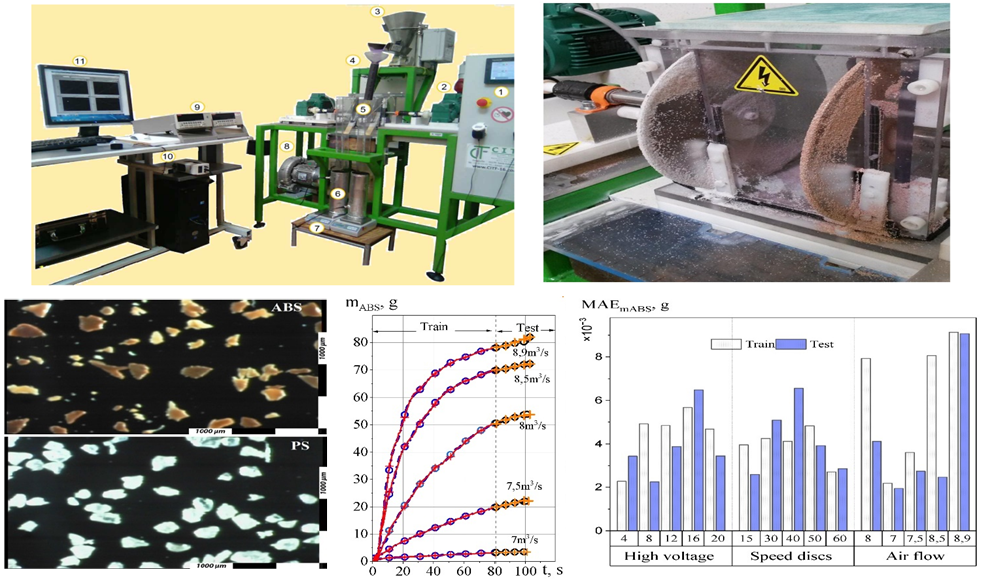
Introduction. The exponential growth of waste electrical and electronic equipment (WEEE) requires efficient strategies for plastic waste management. Plastics, a major fraction of WEEE, represent both an environmental challenge due to low biodegradability and a valuable source of secondary raw materials. Problem. Tribo-aero-electrostatic separators with rotating disk electrodes offer a promising solution for fine plastic separation. However, their performance depends on multiple, nonlinear, and time-varying factors such as disk speed, voltage, and particle properties. These complex interactions make analytical modeling and stable process control difficult, limiting industrial implementation. The goal of this work is to develop a reliable dynamic model based on NARX neural networks capable of predicting the real-time evolution of key process variables such as recovered mass and particle charge. Methodology. The proposed NARX neural network learns temporal nonlinear relationships directly from experimental data, avoiding the need for explicit physical equations. Experiments were conducted on a synthetic 50:50 mixture of Acrylonitrile Butadiene Styrene (ABS) and Polystyrene (PS) particles (500-1000 μm) to assess model performance under varying disk speeds, voltages, and air flow rates. Results. The developed model accurately predicts the recovered mass and acquired charge of both ABS and PS over a wide range of operating conditions. The predictions show strong agreement with experimental measurements, maintaining low error levels even at parameter extremes. Scientific novelty. This work represents the first application of NARX neural networks to model the dynamic behavior of a two-rotating-disk tribo-aero-electrostatic separator. The approach captures essential time-dependent interactions that conventional static or analytical models fail to describe. Practical value. The NARX model exhibits high predictive accuracy and robustness across an extended operating domain (4–20 kV, 15–60 rpm, 7–9 m3/h), with errors limited to the 10–3 g and 10–3 µC ranges. These characteristics demonstrate its potential for real-time intelligent control and adaptive optimization of electrostatic separation processes in plastic waste recycling. References 39, tables 3, figures 9.
References
Geyer R., Jambeck J.R., Law K.L. Production, use, and fate of all plastics ever made. Science Advances, 2017, vol. 3, no. 7, art. no. e1700782. doi: https://doi.org/10.1126/sciadv.1700782.
Menad N., Guignot S., van Houwelingen J.A. New characterisation method of electrical and electronic equipment wastes (WEEE). Waste Management, 2013, vol. 33, no. 3, pp. 706-713. doi: https://doi.org/10.1016/j.wasman.2012.04.007.
Gundupalli S.P., Hait S., Thakur A. A review on automated sorting of source-separated municipal solid waste for recycling. Waste Management, 2017, vol. 60, pp. 56-74. doi: https://doi.org/10.1016/j.wasman.2016.09.015.
Daiku H., Inoue T., Tsukahara M., Maehata H., Kakeda K. Electrostatic separation technology for waste plastics-development of a high-purity type separator for plastics. Proceedings Second International Symposium on Environmentally Conscious Design and Inverse Manufacturing, 2001, pp. 562-565. doi: https://doi.org/10.1109/ECODIM.2001.992424.
Zenkiewicz M., Zuk T. Physical basis of tribocharging and electrostatic separation of plastics. Polimery, 2014, vol. 59, no. 04, pp. 314-323. doi: https://doi.org/10.14314/polimery.2014.314.
Mach F., Adam L., Kacerovský J., Karban P., Doležel I. Evolutionary algorithm-based multi-criteria optimization of triboelectrostatic separator. Journal of Computational and Applied Mathematics, 2014, vol. 270, pp. 134-142. doi: https://doi.org/10.1016/j.cam.2014.02.009.
Mekhalef Benhafssa A., Medles K., Boukhoulda M.F., Tilmatine A., Messal S., Dascalescu L. Study of a Tribo-Aero-Electrostatic Separator for Mixtures of Micronized Insulating Materials. IEEE Transactions on Industry Applications, 2015, vol. 51, no. 5, pp. 4166-4172. doi: https://doi.org/10.1109/TIA.2015.2434794.
Tilmatine A., Benabboun A., Brahmi Y., Bendaoud A., Miloudi M., Dascalescu L. Experimental Investigation of a New Triboelectrostatic Separation Process for Mixed Fine Granular Plastics. IEEE Transactions on Industry Applications, 2014, vol. 50, no. 6, pp. 4245-4250. doi: https://doi.org/10.1109/TIA.2014.2319584.
Achouri I.-E., Boukhoulda M.-F., Medles K., Richard G., Zeghloul T., Dascalescu L. Electrostatic Separation of Tribocharged Granular Mixtures of Two or More Plastics Originating From WEEE. IEEE Transactions on Industry Applications, 2022, vol. 58, no. 6, pp. 7701-7708. doi: https://doi.org/10.1109/TIA.2022.3197544.
Achouri I.-E., Dani C., Zeghloul T., Lungu M., Dascalescu L. Effect of ambient humidity on the tribo-electrostatic separation of granular plastic wastes. Particulate Science and Technology, 2024, vol. 42, no. 6, pp. 908-914. doi: https://doi.org/10.1080/02726351.2023.2295399.
Benabderrahmane A., Dani C., Medles K., Zeghloul T., Tomasella F., Lungu M., Dascalescu L., Parenty A. Effect of storage at different levels of relative humidity of ambient air on the tribo-electrostatic separation of granular plastics containing brominated flame retardants. IEEE Transactions on Industry Applications, 2023, pp. 1-6. doi: https://doi.org/10.1109/TIA.2023.3272872.
Dani C., Achouri I.-E., Zeghloul T., Aouimeur D., Lungu M., Dascalescu L. Triboelectric Charging and Electrostatic Separation of Granular Plastic Wastes Exposed to Long-Term Action of High Levels of Ambient Humidity. IEEE Transactions on Industry Applications, 2025, vol. 61, no. 1, pp. 1194-1201. doi: https://doi.org/10.1109/TIA.2024.3462902.
Achouri I.E., Zeghloul T., Richard G., Medles K., Nouri H., Dscalescu L. Premises for industrial application of a two-rotating-disks-type tribo-aero-electrostatic separator for micronized WEEE. 2017 IEEE Industry Applications Society Annual Meeting, 2017, pp. 1-4. doi: https://doi.org/10.1109/IAS.2017.8101697.
Carlson R. Design of Experiments, Principles and Applications, L. Eriksson, E. Johansson, N. Kettaneh‐ Wold, C. Wikström and S. Wold, Umetrics AB, Umeå Learnways AB, Stockholm, 2000, ISBN 91‐973730‐0‐1, xii + 329 pp. Journal of Chemometrics, 2001, vol. 15, no. 5, pp. 495-496. doi: https://doi.org/10.1002/cem.686.
Nelles O. Nonlinear System Identification. From Classical Approaches to Neural Networks, Fuzzy Models, and Gaussian Processes. Springer, 2020. 1225 p. doi: https://doi.org/10.1007/978-3-030-47439-3.
Haykin S. Neural Networks and Learning Machines. 3rd Ed. Pearson Publ., 2008. 936 p.
Bengharbi A.A., Laribi S., Allaoui T., Mimouni A. Photovoltaic system faults diagnosis using discrete wavelet transform based artificial neural networks. Electrical Engineering & Electromechanics, 2022, no. 6, pp. 42-47. doi: https://doi.org/10.20998/2074-272X.2022.6.07.
Vasilevskij V.V., Poliakov M.O. Reproducing of the humidity curve of power transformers oil using adaptive neuro-fuzzy systems. Electrical Engineering & Electromechanics, 2021, no. 1, pp. 10-14. doi: https://doi.org/10.20998/2074-272X.2021.1.02.
Rouaibia R., Djeghader Y., Moussaoui L. Artificial neural network and discrete wavelet transform for inter-turn short circuit and broken rotor bars faults diagnosis under various operating conditions. Electrical Engineering & Electromechanics, 2024, no. 3, pp. 31-37. doi: https://doi.org/10.20998/2074-272X.2024.3.04.
Touhami S., Medles K., Dahou O., Tilmatine A., Bendaoud A., Dascalescu L. Modeling and Optimization of a Roll-Type Electrostatic Separation Process Using Artificial Neural Networks. IEEE Transactions on Industry Applications, 2013, vol. 49, no. 4, pp. 1773-1780. doi: https://doi.org/10.1109/TIA.2013.2256451.
Dahou O., Medles K., Touhami S., Boukhoulda M.F., Tilmatine A., Dascalescu L. Application of Genetic Algorithms to the Optimization of a Roll-Type Electrostatic Separation Process. IEEE Transactions on Industry Applications, 2011, vol. 47, no. 5, pp. 2218-2223. doi: https://doi.org/10.1109/TIA.2011.2161851.
Dahou O., Touhami S., Ayache Z. Optimal control of an industrial electrostatic rotating electrode separator using artificial intelligence technics. Przegląd Elektrotechniczny, 2019, vol. 95, no. 11, pp. 170-175. doi: https://doi.org/10.15199/48.2019.11.44.
Lai K., Lim S., Teh P., Yeap K. An Artificial Neural Network Approach to Predicting Electrostatic Separation Performance for Food Waste Recovery. Polish Journal of Environmental Studies, 2017, vol. 26, no. 4, pp. 1921-1926. doi: https://doi.org/10.15244/pjoes/68963.
Achouri I.E., Zeghloul T., Medles K., Richard G., Nouri H., Dascalescu L. Tribo-aero-electrostatic separation of micronized waste plastics. ESA ’17 - Annual Meeting of the Electrostatics Society of America, 2017, pp. 1-8. Available at: https://hal.science/hal-04427166 (Accessed 02 May 2025).
Ardakani A.H., Abdollahian S.A., Abdollahi F. NARX Transformer: A Dynamic Model for Leveraging Multicycle Data in Long-Term Battery State of Health Estimation. IEEE Transactions on Instrumentation and Measurement, 2024, vol. 73, pp. 1-8. doi: https://doi.org/10.1109/TIM.2024.3460947.
Ezzeldin R., Hatata A. Application of NARX neural network model for discharge prediction through lateral orifices. Alexandria Engineering Journal, 2018, vol. 57, no. 4, pp. 2991-2998. doi: https://doi.org/10.1016/j.aej.2018.04.001.
Chen C., Chen H., Shi J., Yue D., Shi G., Lyu D. Estimating Lithium-Ion Battery Health Status: A Temporal Deep Learning Approach With Uncertainty Representation. IEEE Sensors Journal, 2025, vol. 25, no. 14, pp. 26931-26943. doi: https://doi.org/10.1109/JSEN.2025.3572291.
Kalaycioglu S., de Ruiter A. Vibration Control of Satellite Antennas via NMPC and NARX Neural Networks. IEEE Transactions on Aerospace and Electronic Systems, 2025, vol. 61, no. 4, pp. 9406-9433. doi: https://doi.org/10.1109/TAES.2025.3551276.
Bouhamri N., Zelmat M.E., Tilmatine A. Micronized plastic waste recycling using two-disc tribo-electrostatic separation process. Advanced Powder Technology, 2019, vol. 30, no. 3, pp. 625-631. doi: https://doi.org/10.1016/j.apt.2018.12.012.
Messal S., Zeghloul T., Mekhalef-Benhafssa A., Medles K., Dascalescu L. Experimental study of a tribo-aero-electrostatic separator for finely-grinded matter. Journal of Electrostatics, 2017, vol. 89, pp. 59-68. doi: https://doi.org/10.1016/j.elstat.2017.08.004.
Zeghloul T., Mekhalef Benhafssa A., Richard G., Medles K., Dascalescu L. Effect of particle size on the tribo-aero-electrostatic separation of plastics. Journal of Electrostatics, 2017, vol. 88, pp. 24-28. doi: https://doi.org/10.1016/j.elstat.2016.12.003.
Achouri I.E., Zeghloul T., Richard G., Medles K., Nouri H., Dascalescu L. Factors that Influence the Performance of a Two-Rotating Disks-Type Tribo-Aero-Electrostatic Separator for Micronized WEEE. IEEE Transactions on Industry Applications, 2019, vol. 55, no. 1, pp. 802-811. doi: https://doi.org/10.1109/TIA.2018.2866546.
Mekhalef Benhafssa A., Zeghloul T., Aksa W., Medles K., Dascalescu L. Continuous operation of a fluidized-bed disk-type electrostatic separator for micronized plastic waste. Waste Management, 2018, vol. 79, pp. 763-769. doi: https://doi.org/10.1016/j.wasman.2018.08.044.
Sjoberg J. Neural networks for modelling and control of dynamic systems, M. Nørgaard, O. Ravn, N. K. Poulsen and L. K. Hansen, Springer, London, 2000, xiv+246pp. International Journal of Robust and Nonlinear Control, 2001, vol. 11, no. 9, pp. 881-882. doi: https://doi.org/10.1002/rnc.585.
Tsungnan Lin, Horne B.G., Tino P., Giles C.L. Learning long-term dependencies in NARX recurrent neural networks. IEEE Transactions on Neural Networks, 1996, vol. 7, no. 6, pp. 1329-1338. doi: https://doi.org/10.1109/72.548162.
Sola J., Sevilla J. Importance of input data normalization for the application of neural networks to complex industrial problems. IEEE Transactions on Nuclear Science, 1997, vol. 44, no. 3, pp. 1464-1468. doi: https://doi.org/10.1109/23.589532.
Salinas D., Flunkert V., Gasthaus J., Januschowski T. DeepAR: Probabilistic forecasting with autoregressive recurrent networks. International Journal of Forecasting, 2020, vol. 36, no. 3, pp. 1181-1191. doi: https://doi.org/10.1016/j.ijforecast.2019.07.001.
Qi M., Zhang G.P. An investigation of model selection criteria for neural network time series forecasting. European Journal of Operational Research, 2001, vol. 132, no. 3, pp. 666-680. doi: https://doi.org/10.1016/S0377-2217(00)00171-5.
Shrestha A., Mahmood A. Review of Deep Learning Algorithms and Architectures. IEEE Access, 2019, vol. 7, pp. 53040-53065. doi: https://doi.org/10.1109/ACCESS.2019.2912200.
Downloads
Published
How to Cite
Issue
Section
License
Copyright (c) 2025 Z. Ayache, O. Dahou

This work is licensed under a Creative Commons Attribution-NonCommercial 4.0 International License.
Authors who publish with this journal agree to the following terms:
1. Authors retain copyright and grant the journal right of first publication with the work simultaneously licensed under a Creative Commons Attribution License that allows others to share the work with an acknowledgement of the work's authorship and initial publication in this journal.
2. Authors are able to enter into separate, additional contractual arrangements for the non-exclusive distribution of the journal's published version of the work (e.g., post it to an institutional repository or publish it in a book), with an acknowledgement of its initial publication in this journal.
3. Authors are permitted and encouraged to post their work online (e.g., in institutional repositories or on their website) prior to and during the submission process, as it can lead to productive exchanges, as well as earlier and greater citation of published work.