Numerical study of particles trajectories in a multifunctional electrostatic separator powered by photovoltaic system
DOI:
https://doi.org/10.20998/2074-272X.2026.1.09Keywords:
electrostatic separation, electric field, photovoltaic system, numerical modeling, particle trajectories, waste electrical and electronic equipmentAbstract
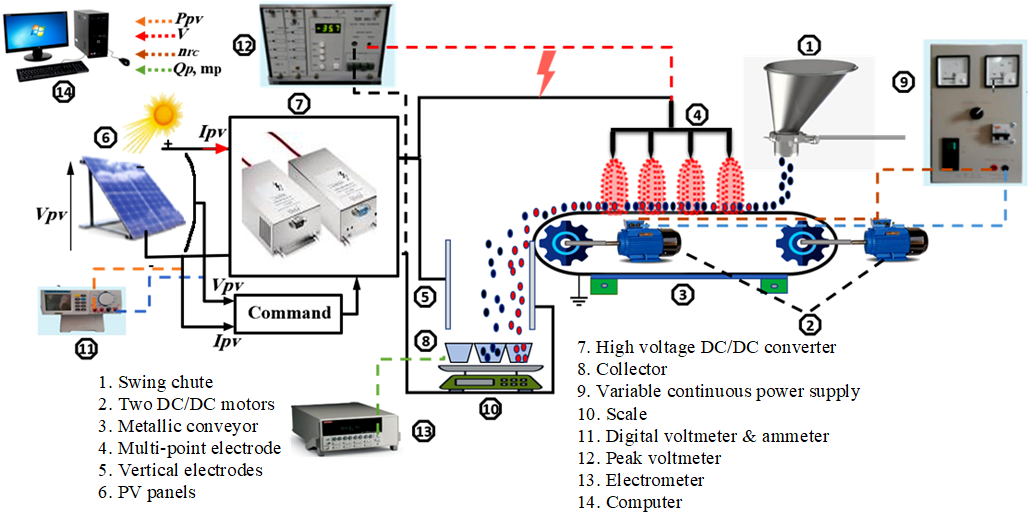
Introduction. Electrostatic separation is a growing technology in the recycling industry. It is an effective technology for processing plastics and metallic materials in the form of granular mixtures or fine powders from waste electrical and electronic equipment. Problem. Understanding the various physical phenomena occurring in the separation zone is crucial for improving the efficiency of electrostatic separation devices. This has led to the adoption of efficient and reliable numerical models for simulating particle trajectories. The goal of the work is to represent graphically the trajectories of two insulating charged polypropylene particles of different sizes (2 mm and 4 mm) in the multifunctional electrostatic separator powered by photovoltaic (PV) system use a multipoint electrodes as charging device employing numerical simulation and demonstrate its effectiveness and reliability for the study of particles trajectories by integrating PV panels as a power source for electrostatic separators according to the recommendations of the new energy system. Methodology. Using the Euler-Cromer method as numerical model to solve the equation of motion of the particles. This method was based on the calculation of the electric field intensity, which is done by the COMSOL Multiphysics software, which uses the finite element method (FEM). The numerical simulation was carried out using MATLAB software by varying the voltage applied to the active electrodes of the multifunctional electrostatic separator suggested, and the distance between them, taking into account the influence of electrostatic and mechanical forces on the charged insulating particles as they pass through the separation zone. The results were showed that the numerical model used is an effective and reliable tool for the study of particles trajectories. Scientific novelty of this work is to integrate PV panels as the main low-voltage energy source at the input of the high-voltage generator supplying the electrostatic separator with an optimal voltage of 30 kV. In addition, this numerical study has used electrostatic forces, gravitational forces, and dynamic forces simultaneously. Practical value. The numerical simulation was contributed to a thorough understanding of various physical phenomena occurring in the separation zone and was considered a tool to validate experimental results. References 31, tables 2, figures 14.
References
Senathirajah K., Attwood S., Bhagwat G., Carbery M., Wilson S., Palanisami T. Estimation of the mass of microplastics ingested – A pivotal first step towards human health risk assessment. Journal of Hazardous Materials, 2021, vol. 404, art. no. 124004. doi: https://doi.org/10.1016/j.jhazmat.2020.124004.
Maammar M., Achouri I.-E., Zeghloul T., Medles K., Aksa W., Dascalescu L. Numerical Simulation and Experimental Observation of Charged Particles Trajectories in Roll-Type Electrostatic Separators. IEEE Transactions on Industry Applications, 2021, vol. 57, no. 6, pp. 6504-6511. doi: https://doi.org/10.1109/TIA.2021.3103485.
Baldé C.P., Kuehr R., Yamamoto T. et al. Global Report on Waste Electrical and Electronic Equipment. The Global E-waste Monitor, 2024. 148 p. Available at: https://ewastemonitor.info/wp-content/uploads/2024/03/GEM_2024_18-03_web_page_per_page_web.pdf (Accessed 07 May 2025).
Guettaf N., Anane Z., El Islem Guettaf S., Hassaine F., Nouri H. Study of the different parameter corona discharge in point-plane Electrostatic Separator. 2022 19th International Multi-Conference on Systems, Signals & Devices (SSD), 2022, pp. 1831-1835. doi: https://doi.org/10.1109/SSD54932.2022.9955502.
Mekhalef Benhafssa A., Medles K., Boukhoulda M.F., Tilmatine A., Messal S., Dascalescu L. Study of a Tribo-Aero-Electrostatic Separator for Mixtures of Micronized Insulating Materials. IEEE Transactions on Industry Applications, 2015, vol. 51, no. 5, pp. 4166-4172. doi: https://doi.org/10.1109/TIA.2015.2434794.
He J., Tang H., Guo C., Zhu L., Huang S., Yang B. Synergist enhancement of effective desilication of graphite ore by rotary triboelectric separation and surface modification. Powder Technology, 2024, vol. 444, art. no. 119965. doi: https://doi.org/10.1016/j.powtec.2024.119965.
He J., Huang S., Chen H., Zhu L., Guo C., He X., Yang B. Recent advances in the intensification of triboelectric separation and its application in resource recovery: A review. Chemical Engineering and Processing - Process Intensification, 2023, vol. 185, art. no. 109308. doi: https://doi.org/10.1016/j.cep.2023.109308.
Pan X., Wong C.W.Y., Li C. Circular economy practices in the waste electrical and electronic equipment (WEEE) industry: A systematic review and future research agendas. Journal of Cleaner Production, 2022, vol. 365, art. no. 132671. doi: https://doi.org/10.1016/j.jclepro.2022.132671.
Bedeković G., Trbović R. Electrostatic separation of aluminium from residue of electric cables recycling process. Waste Management, 2020, vol. 108, pp. 21-27. doi: https://doi.org/10.1016/j.wasman.2020.04.033.
Perdana T., Kusnandar K., Perdana H.H., Hermiatin F.R. Circular supply chain governance for sustainable fresh agricultural products: Minimizing food loss and utilizing agricultural waste. Sustainable Production and Consumption, 2023, vol. 41, pp. 391-403. doi: https://doi.org/10.1016/j.spc.2023.09.001.
Radebe N., Chipangamate N. Mining industry risks, and future critical minerals and metals supply chain resilience in emerging markets. Resources Policy, 2024, vol. 91, art. no. 104887. doi: https://doi.org/10.1016/j.resourpol.2024.104887.
Sun B., Li B., Ma S., Zhu M., Dong C., Xiang M., Cheng H., Yu Y. The recycling potential of unregulated waste electrical and electronic equipment in China: Generation, economic value, and cost-benefit analysis. Journal of Cleaner Production, 2023, vol. 402, art. no. 136702. doi: https://doi.org/10.1016/j.jclepro.2023.136702.
Shahabuddin M., Uddin M.N., Chowdhury J.I., Ahmed S.F., Uddin M.N., Mofijur M., Uddin M.A. A review of the recent development, challenges, and opportunities of electronic waste (e-waste). International Journal of Environmental Science and Technology, 2023, vol. 20, no. 4, pp. 4513-4520. doi: https://doi.org/10.1007/s13762-022-04274-w.
Gao Y., Huang X., Xia D., Lyu C. Research on the recycling decision of WEEE in rural China under dual supervision. Scientific Reports, 2024, vol. 14, no. 1, art. no. 23875. doi: https://doi.org/10.1038/s41598-024-74158-1.
Catinean A., Dascalescu L., Lungu M., Dumitran L.M., Samuila A. Improving the recovery of copper from electric cable waste derived from automotive industry by corona-electrostatic separation. Particulate Science and Technology, 2021, vol. 39, no. 4, pp. 449-456. doi: https://doi.org/10.1080/02726351.2020.1756545.
Zeghloul T., Touhami S., Richard G., Miloudi M., Dahou O., Dascalescu L. Optimal Operation of a Plate-Type Corona-Electrostatic Separator for the Recovery of Metals and Plastics from Granular Wastes. IEEE Transactions on Industry Applications, 2016, vol. 52, no. 3, pp. 2506-2512. doi: https://doi.org/10.1109/TIA.2016.2533482.
Touhami S., Aksa W., Medles K., Tilmatine A., Dascalescu L. Numerical Simulation of the Trajectories of Insulating Particles in a Tribo-Aero-Electrostatic Separator. IEEE Transactions on Industry Applications, 2015, vol. 51, no. 5, pp. 4151-4158. doi: https://doi.org/10.1109/TIA.2015.2427276.
Tilmatine A., Benabboun A., Brahmi Y., Bendaoud A., Miloudi M., Dascalescu L. Experimental Investigation of a New Triboelectrostatic Separation Process for Mixed Fine Granular Plastics. IEEE Transactions on Industry Applications, 2014, vol. 50, no. 6, pp. 4245-4250. doi: https://doi.org/10.1109/TIA.2014.2319584.
Kimi I.E., Benhammou A., Touhami S., Rezoug M. Numerical modelling and experimental validation of an Enhanced multi-force model of free-fall electrostatic separators. Particulate Science and Technology, 2025, vol. 43, no. 1, pp. 52-64. doi: https://doi.org/10.1080/02726351.2024.2417363.
Székely L., Kiss I., Donghyeok G. Investigation of the separation of conductive and insulating objects on a laboratory made electrostatic separator. Journal of Physics: Conference Series, 2024, vol. 2702, no. 1, art. no. 012010. doi: https://doi.org/10.1088/1742-6596/2702/1/012010.
Latreche K., Taleb R., Bentaallah A., Toubal Maamar A.E., Helaimi M., Chabni F. Design and experimental implementation of voltage control scheme using the coefficient diagram method based PID controller for two-level boost converter with photovoltaic system. Electrical Engineering & Electromechanics, 2024, no. 1, pp. 3-9. doi: https://doi.org/10.20998/2074-272X.2024.1.01.
Bounechba H., Boussaid A., Bouzid A. Experimental validation of fuzzy logic controller based on voltage perturbation algorithm in battery storage photovoltaic system. Electrical Engineering & Electromechanics, 2024, no. 5, pp. 20-27. doi: https://doi.org/10.20998/2074-272X.2024.5.03.
Zorig A., Babes B., Hamouda N., Mouassa S. Improving the efficiency of a non-ideal grid coupled to a photovoltaic system with a shunt active power filter using a self-tuning filter and a predictive current controller. Electrical Engineering & Electromechanics, 2024, no. 6, pp. 33-43. doi: https://doi.org/10.20998/2074-272X.2024.6.05.
Guettaf N., Said H.A., Aissou M., Zegloul T., Nouri H. Modeling a Corona Discharge Separation of Fine Particles for Different Materials Used in Electrical Engineering. Advanced Engineering Forum, 2025, vol. 54, pp. 77-90. doi: https://doi.org/10.4028/p-U8GCnx.
Grechko O.M. Influence of the poles shape of DC electromagnetic actuator on its thrust characteristic. Technical Electrodynamics, 2024, no. 1, pp. 38-45. doi: https://doi.org/10.15407/techned2024.01.038.
Ireland P.M. Modelling dense particle streams during free-fall electrostatic separation. Powder Technology, 2024, vol. 434, art. no. 119290. doi: https://doi.org/10.1016/j.powtec.2023.119290.
Qin Y., Gao K., Li J., Xu Z. Particle trajectory model for tribo-electrostatic separating mixed granular plastics. Cleaner Engineering and Technology, 2021, vol. 4, art. no. 100219. doi: https://doi.org/10.1016/j.clet.2021.100219.
Maammar M., Touhami S., Rezoug M., Daioui K., Dascalescu L., Medles K. Experimental study and numerical simulation of particles trajectories in a flexible-electrode-type electrostatic separator. Journal of Physics: Conference Series, 2024, vol. 2702, no. 1, art. no. 012018. doi: https://doi.org/10.1088/1742-6596/2702/1/012018.
Xu Z., Li J., Lu H., Wu J. Dynamics of conductive and nonconductive particles under high-voltage electrostatic coupling fields. Science in China Series E: Technological Sciences, 2009, vol. 52, no. 8, pp. 2359-2366. doi: https://doi.org/10.1007/s11431-008-0198-2.
Labair H., Touhami S., Tilmatine A., Hadjeri S., Medles K., Dascalescu L. Study of charged particles trajectories in free-fall electrostatic separators. Journal of Electrostatics, 2017, vol. 88, pp. 10-14. doi: https://doi.org/10.1016/j.elstat.2017.01.010.
Touhami S., Aksa W., Maammar M., Zeghloul T., Medles K., Dascalescu L. Numerical simulation of the behavior of insulating particles in a free fall tribo-electrostatic separator with four vertical cylindrical electrodes. Journal of Electrostatics, 2019, vol. 97, pp. 8-14. doi: https://doi.org/10.1016/j.elstat.2018.11.004.
Downloads
Published
How to Cite
Issue
Section
License
Copyright (c) 2025 N. Guettaf, S. E. I. Guettaf, T. Zeghloul, H. Nouri

This work is licensed under a Creative Commons Attribution-NonCommercial 4.0 International License.
Authors who publish with this journal agree to the following terms:
1. Authors retain copyright and grant the journal right of first publication with the work simultaneously licensed under a Creative Commons Attribution License that allows others to share the work with an acknowledgement of the work's authorship and initial publication in this journal.
2. Authors are able to enter into separate, additional contractual arrangements for the non-exclusive distribution of the journal's published version of the work (e.g., post it to an institutional repository or publish it in a book), with an acknowledgement of its initial publication in this journal.
3. Authors are permitted and encouraged to post their work online (e.g., in institutional repositories or on their website) prior to and during the submission process, as it can lead to productive exchanges, as well as earlier and greater citation of published work.