Possibility of cooling the rotor of an electric traction motor by bidirectional air flows
DOI:
https://doi.org/10.20998/2074-272X.2026.3.04Keywords:
permanent magnet synchronous motor, combined cooling method, computational fluid dynamics, fan design, hollow shaftAbstract
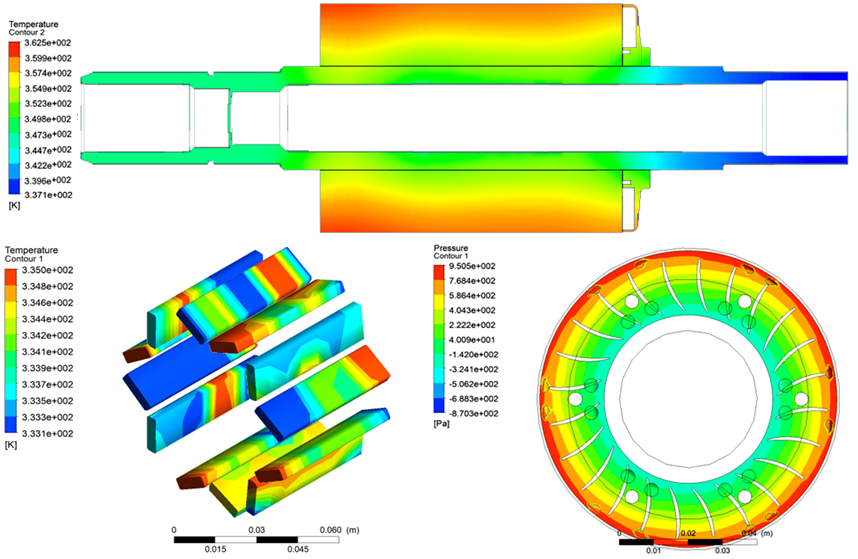
Introduction. The performance reliability of electric vehicles (EVs) is an important factor in evaluating their suitability for widespread adoption. The reliability and lifespan of an EV depend on several critical factors including the motor, battery pack, controllers, and thermal management systems. The problem addressed in this paper is to cool down the rotor of permanent magnet synchronous motor efficiently using new combined cooling methods. Goal. Determination of the effectiveness of the combined rotor cooling method, which includes a bidirectional airflow circulating through a designed fan and oil circulation in the hollow shaft. Methodology. The solution was carried out using CFD (computational fluid dynamics) analysis. Results. A numerical model of a new combined cooling method for the rotor, which taking into account heat generation in the rotor and the thermal influence of the stator and bearing units, based on heat flow equations that consider its laminar or turbulent nature, was developed and studied. Scientific novelty. Based on the analysis of the rotor’s numerical model, a fan design was proposed that allows for effective heat dissipation by creating bidirectional airflow circulation. Practical value. The developed model can be used for further research on the dynamic thermal parameters of the rotor and evaluation of heat dissipation efficiency, which will optimize the heat and mass transfer processes within the motor, enhance its operational efficiency, and ensure the stability of its performance in various operating modes. References 21, tables 5, figures 17.
References
Usman A., Saxena A. Technical Roadmaps of Electric Motor Technology for Next Generation Electric Vehicles. Machines, 2025, vol. 13, no. 2, art. no. 156. doi: https://doi.org/10.3390/machines13020156.
Biot-Monterde V., Navarro-Navarro A., Zamudio-Ramirez I., Antonino-Daviu J., Osornio-Rios R.A., Ruiz-Sarrió J.E. Automatic classification of stator asymmetries and insulation thermal damages in induction motors, applying persistence spectrum and a convolutional neural network to the stray-flux signals. 2023 IEEE 32nd International Symposium on Industrial Electronics (ISIE), 2023, pp. 1-6. doi: https://doi.org/10.1109/ISIE51358.2023.10227984.
Sun W., Gao F. Failure Analysis of Irreversible Demagnetization of Permanent Magnet Synchronous Motor. 2024 11th International Forum on Electrical Engineering and Automation (IFEEA), 2024, pp. 761-764. doi: https://doi.org/10.1109/IFEEA64237.2024.10878522.
Neusues S., Binder A. Post rotor-fault operation of a Ferrite Magnet assisted Synchronous Reluctance Motor. 2020 International Conference on Electrical Machines (ICEM), 2020, pp. 2335-2341. doi: https://doi.org/10.1109/ICEM49940.2020.9271011.
Fu J., Li H., Sun X., He T., Zhang G., Wei C. Multi-physics simulation modeling and energy flow characterization of thermal management system for a sport utility vehicle under high-temperature conditions. Energy, 2025, vol. 316, art, no. 134653. doi: https://doi.org/10.1016/j.energy.2025.134653.
Malik M.A.I., Kalam M.A., Ikram A., Zeeshan S., Raza Zahidi S.Q. Energy transition towards electric vehicle technology: Recent advancements. Energy Reports, 2025, vol. 13, pp. 2958-2996. doi: https://doi.org/10.1016/j.egyr.2025.02.029.
Dan D., Zhao Y., Wei M., Wang X. Review of Thermal Management Technology for Electric Vehicles. Energies, 2023, vol. 16, no. 12, art. no. 4693. doi: https://doi.org/10.3390/en16124693.
Wu J., Shan L., Peng G., Wang R., Zhang W., Tong X., Shen L. A Review of Motor Drive Thermal Management System for Electric Vehicles. 2022 7th International Conference on Power and Renewable Energy (ICPRE), 2022, pp. 551-556. doi: https://doi.org/10.1109/ICPRE55555.2022.9960497.
Gronwald P.-O., Kern T.A. Traction Motor Cooling Systems: A Literature Review and Comparative Study. IEEE Transactions on Transportation Electrification, 2021, vol. 7, no. 4, pp. 2892-2913. doi: https://doi.org/10.1109/TTE.2021.3075844.
Bourgault A.J., Roy P., Ghosh E., Kar N.C. A Survey of Different Cooling Methods for Traction Motor Application. 2019 IEEE Canadian Conference of Electrical and Computer Engineering (CCECE), 2019, pp. 1-4. doi: https://doi.org/10.1109/CCECE.2019.8861611.
Gundabattini E., Kuppan R., Solomon D.G., Kalam A., Kothari D.P., Abu Bakar R. A review on methods of finding losses and cooling methods to increase efficiency of electric machines. Ain Shams Engineering Journal, 2021, vol. 12, no. 1, pp. 497-505. doi: https://doi.org/10.1016/j.asej.2020.08.014.
Li X., Zhao X., Zhang Z., Avelin A., Liu S., Li H. Selecting cooling methods for electric motors. Applied Thermal Engineering, 2025, vol. 274, art. no. 126554. doi: https://doi.org/10.1016/j.applthermaleng.2025.126554.
Cengel Y.A., Cimbala J.M., Ghajar A.J. Fundamentals of Thermal-Fluid Sciences. 6th edition. McGraw Hill, 2022. 977 p.
Dheivanai R., Prasanth B., Karthikeyan G. Evaluation and Simulation of Oil-based Direct Cooling System in Series DC Motors for Electric Vehicle Applications. Iranian Journal of Science and Technology, Transactions of Electrical Engineering, 2025. doi: https://doi.org/10.1007/s40998-025-00833-2.
Szajding A., Gołdasz A., Telejko T. The influence of coolant velocity on the local heat transfer coefficient during steel quenching. Computer Methods in Material Science, 2020, vol. 20, no. 4, pp. 157-164. doi: https://doi.org/10.7494/cmms.2020.4.0737.
Zhang T., Yao J., Liao S., Liu X., Xu Y., Yang S. Cooling enhancement of permanent magnet synchronous motor coupled with heat pipes for electric vehicle. Applied Thermal Engineering, 2025, vol. 279, art. no. 127572. doi: https://doi.org/10.1016/j.applthermaleng.2025.127572.
Milykh V.I. Numerical-field analysis of active and reactive winding parameters and mechanical characteristics of a squirrel-cage induction motor. Electrical Engineering & Electromechanics, 2023, no. 4, pp. 3-13. doi: https://doi.org/10.20998/2074-272X.2023.4.01.
Petrov I., Martikainen I., Poutiainen I., Rangwala J., Pyrhönen J. Hairpin Winding with Direct Oil Cooling. 2024 International Conference on Electrical Machines (ICEM), 2024, pp. 1-7. doi: https://doi.org/10.1109/ICEM60801.2024.10700210.
Ibrar A., Ahmad S., Safdar A., Haroon N. Efficiency enhancement strategy implementation in hybrid electric vehicles using sliding mode control. Electrical Engineering & Electromechanics, 2023, no. 1, pp. 10-19. doi: https://doi.org/10.20998/2074-272X.2023.1.02.
Bergman T.L., Lavine A.S., Incropera F.P., DeWitt D.P. Introduction to Heat Transfer. 6th edition. John Wiley & Sons, Inc., 2011. 1040 p.
Milykh V.I. Theory and practice of numerical-field analysis and refinement of electromagnetic and energy parameters in the designs of three-phase induction motors. Electrical Engineering & Electromechanics, 2026, no. 1, pp. 3-14. doi: https://doi.org/10.20998/2074-272X.2026.1.01.
Downloads
Published
How to Cite
Issue
Section
License
Copyright (c) 2026 S. Shlyk, J. Pyrhonen, I. Petrov, M. Parviainen, I. Martikainen, A. Suikki, J. Pippuri-Makelainen, M. Zagirnyak

This work is licensed under a Creative Commons Attribution-NonCommercial 4.0 International License.
Authors who publish with this journal agree to the following terms:
1. Authors retain copyright and grant the journal right of first publication with the work simultaneously licensed under a Creative Commons Attribution License that allows others to share the work with an acknowledgement of the work's authorship and initial publication in this journal.
2. Authors are able to enter into separate, additional contractual arrangements for the non-exclusive distribution of the journal's published version of the work (e.g., post it to an institutional repository or publish it in a book), with an acknowledgement of its initial publication in this journal.
3. Authors are permitted and encouraged to post their work online (e.g., in institutional repositories or on their website) prior to and during the submission process, as it can lead to productive exchanges, as well as earlier and greater citation of published work.