Determination of the transition resistance of detachable electrical contacts with Camital active grease
DOI:
https://doi.org/10.20998/2074-272X.2026.3.03Keywords:
electrical contact, contact resistance, composite electrical grease, Camital, shape memory alloy, thermal, thermomechanical and tribological processesAbstract
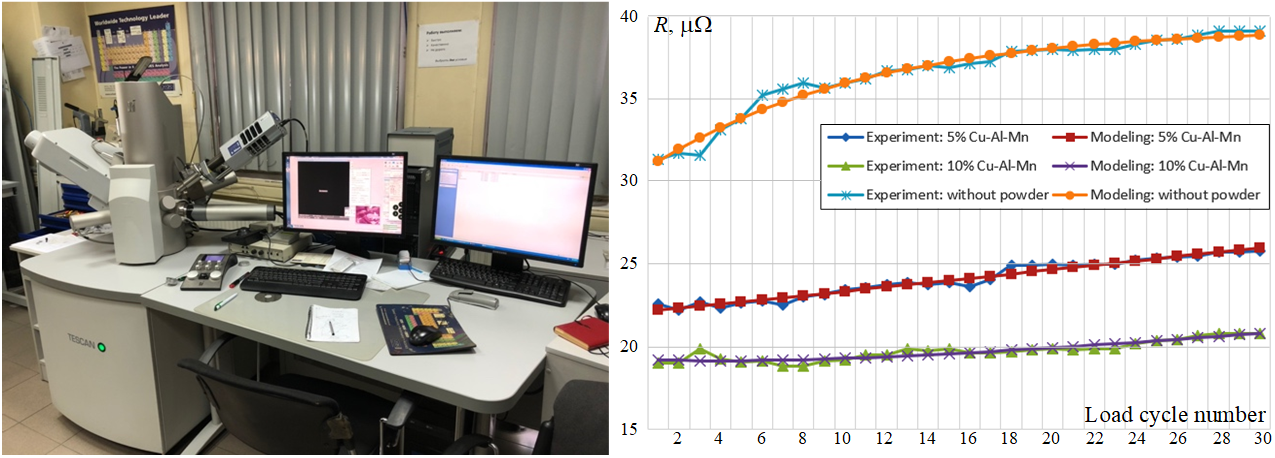
Problem. The reliability of detachable electrical contact connections is significantly reduced due to an increase in transition electrical resistance caused by thermomechanical deformations, oxidation of contact surfaces, and a decrease in the effective contact area during operation. According to the results of operational and experimental studies, failures associated with contact degradation account for up to a third of the total number of electrical installation failures. Traditional methods, in particular the use of passive conductive lubricants, mostly only slow down oxidation processes and do not ensure active restoration of the contact condition. In this regard, it is important to develop models and technical solutions capable of describing and ensuring the stabilisation of the transition resistance of electrical contacts through controlled thermomechanical processes in the contact zone. Goal. To establish the regularities and interrelationships of processes in electrical contacts through experimental research and mathematical modelling of the evolution of the transition resistance of contact connections with composite grease modified with Cu–Al–Mn (Camital) with shape memory, taking into account the interaction of electrical, thermal, thermomechanical and tribological processes in normal and emergency operating modes. Methodology. Experimental studies were performed on models of bolted contact connections of aluminum busbars using composite grease containing 5 % and 10 % Cu–Al–Mn powder by volume, as well as on control samples without grease. Long-term measurements of contact resistance were carried out at a constant temperature and under periodic thermal loads. The theoretical study is based on a multilevel mathematical model, the numerical solution of which was carried out using implicit stable methods with parameter identification based on experimental data. Results. A decrease and stabilisation of contact resistance was established when using composite lubricant, most pronounced at a Cu–Al–Mn powder content of 10 % by volume. A reduced model of contact resistance evolution was proposed. Scientific novelty. For the first time, a generalised mathematical model of a detachable electrical contact with active composite lubricant has been developed, which takes into account the phase transformations of Cu–Al–Mn alloy particles and the mechanism of thermomechanical destruction of oxide films. The possibility of a step-like decrease in contact resistance under impulse currents is shown. Practical value. The results obtained can be used to improve the reliability of detachable electrical contact connections, predict changes in contact resistance during operation, and justify the choice of the composition of active electrical contact lubricants. References 37, tables 4, figures 7.
References
Kozyrskyi V. Analysis of condition control parameters and prediction of the aging process of dismountable type contacts. Energetics and electrification, 2002, no. 6, pp. 16-18. (Ukr).
Kozyrskyi V. Analysis of the principles of stabilization of contact pressure in collapsible contact systems. Proceedings of the Institute of Electrodynamics of the National Academy of Sciences of Ukraine, 2001, pp. 115-116. (Ukr).
Tkachuk I., Kozyrskyi V. Method for flexible manufacturing of intermetallic compounds and device for making thereof. Patent WO 2021/212188, PCT/BG2020/000017, 28.10.2021.
Zhang J., Chen T., Su G., Li C., Zhao F., Mi W. Microstructure and component analysis of glowing contacts in electrical fire investigation. Engineering Failure Analysis, 2022, vol. 140, art. no. 106539. doi: https://doi.org/10.1016/j.engfailanal.2022.106539.
Kloch K.T., Kozak P., Mlyniec A. A review and perspectives on predicting the performance and durability of electrical contacts in automotive applications. Engineering Failure Analysis, 2021, vol. 121, art. no. 105143. doi: https://doi.org/10.1016/j.engfailanal.2020.105143.
Sampaio R.F., Pragana J.P., Bragança I.M., Silva C.M., Nielsen C.V, Martins P.A. Electric performance of fastened hybrid busbars: An experimental and numerical study. Proceedings of the Institution of Mechanical Engineers, Part L: Journal of Materials: Design and Applications, 2022, vol. 236, no. 6, pp. 1152-1163. doi: https://doi.org/10.1177/14644207211043009.
Kozyrskyi V., Tkachuk I., Voloshyn S. Electrical contact connection. Patent WO 2023/060325, PCT/BG2021/000025, 20.04.2023.
Camital brand registration certificate no. 163545. Available at: https://alotek.international/uploads/230/1jgmO5anW3WCOVP22n2bZsx7RSeMc9-metaQ2FtaXRhbCDQodCy0LjQtNC10YLQtdC70YHRgtCy0L4r0LfQsCvRgNC10LPQuNGB0YLRgNCw0YbQuNGPLnBkZg==-.pdf (Accessed 20 May 2025).
Kozyrskyi V., Kaplun V., Voloshyn S. Functional intermetallics in power plants. Kyiv, Comprint, 2021. 347 p. (Ukr). Available at: https://dglib.nubip.edu.ua/server/api/core/bitstreams/c4cb1972-74d6-44d0-a13e-6f0c1d7efa61/content.
Alderete B., Mücklich F., Suarez S. Characterization and electrical analysis of carbon-based solid lubricant coatings. Carbon Trends, 2022, vol. 7, art. no. 100156. doi: https://doi.org/10.1016/j.cartre.2022.100156.
Zhou Y., Liu J., Li X., Chong H., Han B., Bai Q. On the electric behaviour of conductive grease inside the contact zone. Friction, 2024, vol. 12, no. 4, pp. 683-697. doi: https://doi.org/10.1007/s40544-023-0784-0.
Gonda A., Capan R., Bechev D., Sauer B. The Influence of Lubricant Conductivity on Bearing Currents in the Case of Rolling Bearing Greases. Lubricants, 2019, vol. 7, no. 12, art. no. 108. doi: https://doi.org/10.3390/lubricants7120108.
Zhang X., Glovnea R. An experimental investigation of grease lubricated EHD contact subjected to normal sinusoidally variable loading. Tribology International, 2020, vol. 147, art. no. 106272. doi: https://doi.org/10.1016/j.triboint.2020.106272.
Sampaio R.F.V., Pragana J.P.M., Bragança I.M.F., Silva C.M.A., Fernandes J.C.S., Martins P.A.F. Influence of corrosion on the electrical and mechanical performance of hybrid busbars. International Journal of Lightweight Materials and Manufacture, 2022, vol. 5, no. 4, pp. 510-519. doi: https://doi.org/10.1016/j.ijlmm.2022.06.005.
Vanyorek L., Kiss D., Prekob Á., Fiser B., Potyka A., Németh G., Kuzsela L., Drees D., Trohák A., Viskolcz B. Application of nitrogen doped bamboo-like carbon nanotube for development of electrically conductive lubricants. Journal of Materials Research and Technology, 2019, vol. 8, no. 3, pp. 3244-3250. doi: https://doi.org/10.1016/j.jmrt.2019.05.012.
Hong H., Christensen G., Widener C. Carbon nanotube grease and sustainable manufacturing. Procedia Manufacturing, 2018, vol. 21, pp. 623-629. doi: https://doi.org/10.1016/j.promfg.2018.02.164.
Frache L., Komba E.H., Philippon D., Galipaud J., De Barros M.I., Douillard T., Masenelli-Varlot K., Bouscharain N., Maheo Y., Sarlin R., Le Jeune G., Berthier Y., Bou-Said B., Massi F. Observation of a modified superficial layer on heavily loaded contacts under grease lubrication. Tribology International, 2021, vol. 158, art. no. 106921. https://doi.org/10.1016/j.triboint.2021.106921.
Van Humbeeck J. Non-medical applications of shape memory alloys. Materials Science and Engineering: A, 1999, vol. 273-275, pp. 134-148. doi: https://doi.org/10.1016/S0921-5093(99)00293-2.
Sutou Y., Koeda N., Omori T., Kainuma R., Ishida K. Effects of ageing on bainitic and thermally induced martensitic transformations in ductile Cu–Al–Mn-based shape memory alloys. Acta Materialia, 2009, vol. 57, no. 19, pp. 5748-5758. doi: https://doi.org/10.1016/j.actamat.2009.08.003.
Kainuma R., Takahashi S., Ishida K. Ductile Shape Memory Alloys of the Cu-Al-Mn System. Journal de Physique IV, 1995, vol. 5, no. C8, pp. 961-966. doi: https://doi.org/10.1051/jp4/199558961.
Liu J.-L., Huang H.-Y., Xie J.-X. Superelastic anisotropy characteristics of columnar-grained Cu–Al–Mn shape memory alloys and its potential applications. Materials & Design, 2015, vol. 85, pp. 211-220. doi: https://doi.org/10.1016/j.matdes.2015.06.114.
Liu J.-L., Huang H.-Y., Xie J.-X., Xu S., Li F. Superelastic fatigue of columnar-grained Cu-Al-Mn shape memory alloy under cyclic tension at high strain. Scripta Materialia, 2017, vol. 136, pp. 106-110. doi: https://doi.org/10.1016/j.scriptamat.2017.04.017.
Wang H., Huang H.-Y., Su Y.-J. Tuning the operation temperature window of the elastocaloric effect in Cu–Al–Mn shape memory alloys by composition design. Journal of Alloys and Compounds, 2020, vol. 828, art. no. 154265. doi: https://doi.org/10.1016/j.jallcom.2020.154265.
TESCAN microscopy. Available at: https://tescan.com.
Holm R. Electric Contacts. Theory and Application. Springer, Berlin, 1967. 503 p. Available at: https://www.scribd.com/document/675204141/1967-R-Holm-Electric-Contacts.
Slade P.G. Electrical Contacts. Principles and Applications. CRC Press, 2014. 1311 p. doi: https://doi.org/10.1201/b15640.
Greenwood J.A., Williamson J.B.P. Contact of nominally flat surfaces. Proceedings of the Royal Society of London. Series A. Mathematical and Physical Sciences, 1966, vol. 295, no. 1442, pp. 300-319. doi: https://doi.org/10.1098/rspa.1966.0242.
Bergman T., Lavine A.S., Incropera F.P., DeWitt D.P. Fundamentals of Heat and Mass Transfer. John Wiley & Sons, 2007. 1048 p.
Otsuka K., Wayman C.M. Shape Memory Materials. Cambridge University Press, 1998. 284 p.
Lagoudas D.C. Shape Memory Alloys. Modelling and Engineering Applications. Springer, 2008. 436 p. doi: https://doi.org/10.1007/978-0-387-47685-8.
Sutou Y., Omori T., Wang J.J., Kainuma R., Ishida K. Characteristics of Cu–Al–Mn-based shape memory alloys and their applications. Materials Science and Engineering: A, 2004, vol. 378, no. 1–2, pp. 278-282. doi: https://doi.org/10.1016/j.msea.2003.12.048.
Bowden F.P., Tabor D. The Friction and Lubrication of Solids. Oxford University Press, 2001. 424 p. doi: https://doi.org/10.1093/oso/9780198507772.001.0001.
Rabinowicz E. Friction and Wear of Materials. John Wiley and Sons, New York. 1995. 342 p.
Hairer E., Wanner G. Solving Ordinary Differential Equations II. Stiff and Differential - Algebraic Problems. Springer Berlin Heidelberg, 1991. 604 p. doi: https://doi.org/10.1007/978-3-662-09947-6.
Shampine L.F. Numerical Solution of Ordinary Differential Equations. Chapman & Hall, 1994. 632 p.
Ljung L. System Identification. Theory for the User. Prentice Hall, 1999. 609 p.
Seber G.A.F., Wild C.J. Nonlinear Regression. Wiley, 2003. 798 p.
Downloads
Published
How to Cite
Issue
Section
License
Copyright (c) 2026 V. V. Kozyrskyi, V. Ya. Bunko, P. M. Darmoris

This work is licensed under a Creative Commons Attribution-NonCommercial 4.0 International License.
Authors who publish with this journal agree to the following terms:
1. Authors retain copyright and grant the journal right of first publication with the work simultaneously licensed under a Creative Commons Attribution License that allows others to share the work with an acknowledgement of the work's authorship and initial publication in this journal.
2. Authors are able to enter into separate, additional contractual arrangements for the non-exclusive distribution of the journal's published version of the work (e.g., post it to an institutional repository or publish it in a book), with an acknowledgement of its initial publication in this journal.
3. Authors are permitted and encouraged to post their work online (e.g., in institutional repositories or on their website) prior to and during the submission process, as it can lead to productive exchanges, as well as earlier and greater citation of published work.