Performance improvement of sensorless scalar and vector control for induction motor drives via an enhanced voltage model
DOI:
https://doi.org/10.20998/2074-272X.2026.3.09Keywords:
induction motor, sensorless control, scalar control, field-oriented control, model reference adaptive system, stator resistance estimationAbstract
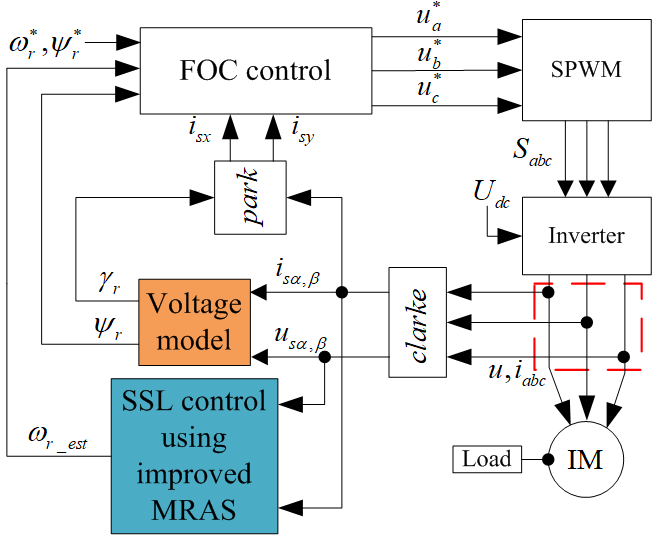
Introduction. Scalar control (SC) and field-oriented control (FOC) are widely used in sensorless induction motor (IM) drives for their balance of performance and cost. Among estimation techniques, the voltage-model (VM) based model reference adaptive system (MRAS) is preferred in industry due to its simple structure and low computational load. Problem. Traditional VM-based MRAS schemes are highly sensitive to parameter uncertainties, especially to variations in stator resistance Rs caused by temperature changes. These variations degrade flux estimation accuracy, leading to significant speed-tracking errors, increased transients, and reduced stability in both SC and FOC. Goal. This study quantitatively evaluates how the estimation of stator resistance Rs and the dependent rotor resistance Rr affects the speed-control performance of sensorless SC and FOC under parameter mismatch. Methodology. An improved VM-based MRAS is proposed with parallel Rs estimation and Rr updated via a linear relation to Rs. Estimator stability and convergence are proven using Lyapunov theory. The estimator is integrated into SC and FOC and tested in MATLAB/Simulink under identical conditions, including a sudden 30 % increase in resistance. Speed tracking is quantified using the integral of time-weighted absolute error (ITAE). Results. Parameter estimation markedly enhances the robustness of both strategies. In sensorless SC, ITAE drops by about 66.2 % (5.512 to 1.863), indicating much lower transient oscillations. In sensorless FOC, ITAE falls by about 54 % (0.7075 to 0.323), with speed overshoot nearly eliminated (0.031). Scientific novelty. The study provides a unified quantitative comparison of sensorless SC and FOC using ITAE under identical operating and estimation conditions, revealing different levels of performance recovery with the proposed dual-resistance adaptation. Practical value. The findings guide the design of more reliable industrial IM drives, showing that while FOC retains superior dynamics, SC with estimation becomes a robust, cost-effective option for applications with significant parameter uncertainty. References 31, table 1, figures 13.
References
Ibrar A., Ahmad S., Safdar A., Haroon N. Efficiency enhancement strategy implementation in hybrid electric vehicles using sliding mode control. Electrical Engineering & Electromechanics, 2023, no. 1, pp. 10-19. doi: https://doi.org/10.20998/2074-272X.2023.1.02.
Tiwari D., Miscandlon J., Tiwari A., Jewell G.W. A Review of Circular Economy Research for Electric Motors and the Role of Industry 4.0 Technologies. Sustainability, 2021, vol. 13, no. 17, art. no. 9668. doi: https://doi.org/10.3390/su13179668.
Liyanage A., Nagrial M., Hellany A., Rizk J. Speed Control of Induction Motors Using V/f Control Method. 2022 International Conference on Electrical and Computing Technologies and Applications (ICECTA), 2022, pp. 424-429. doi: https://doi.org/10.1109/ICECTA57148.2022.9990374.
Saleh S.A. The Development and Performance Testing of a V/f Control for Induction Motors Fed by Wavelet Modulated Power Electronic Converters. IEEE Transactions on Industry Applications, 2024, vol. 60, no. 3, pp. 5012-5024. doi: https://doi.org/10.1109/TIA.2024.3362918.
Keskin B., Eminoglu I. Optimally Tuned PI Controller Design for V/f Control of Induction Motor. 2022 International Congress on Human-Computer Interaction, Optimization and Robotic Applications (HORA), 2022, pp. 1-5. doi: https://doi.org/10.1109/HORA55278.2022.9800005.
Son D.-H., Kim S.-A. Simplified V/f Control Algorithm for Reduction of Current Fluctuations in Variable-Speed Operation of Induction Motors. Energies, 2024, vol. 17, no. 7, art. no. 1699. doi: https://doi.org/10.3390/en17071699.
Shekher V., Sisodiya A., Sinha A.K., Harsh H., Soren N. Optimal tuning of PID controller for V/f control of linear induction motor using artificial biological intelligence. Franklin Open, 2024, vol. 9, art. no. 100183. doi: https://doi.org/10.1016/j.fraope.2024.100183.
Choi S.-C., Kim J.-H., Yoon Y.-D., Hong C.-O., Park C.-H., Cho J.-H. V/F Control Method for Pulsating Torque Reduction in a Single Phase Induction Motor. 2023 IEEE International Symposium on Sensorless Control for Electrical Drives (SLED), 2023, pp. 1-6. doi: https://doi.org/10.1109/SLED57582.2023.10261379.
Zellouma D., Bekakra Y., Benbouhenni H. Field-oriented control based on parallel proportional–integral controllers of induction motor drive. Energy Reports, 2023, vol. 9, pp. 4846-4860. doi: https://doi.org/10.1016/j.egyr.2023.04.008.
Tran C.D., Kuchar M., Nguyen P.D. Improved Rotor Flux Estimation For Field-Oriented Control In Induction Motor Drives. Tekhnichna Elektrodynamika, 2025, no. 6, pp. 52-57. doi: https://doi.org/10.15407/techned2025.06.052.
Tran C.D., Kuchar M., Sotola V., Nguyen P.D. Sensor fault diagnosis strategy based on rotor flux observers in three-phase induction motor drive. Scientific Reports, 2025, vol. 16, no. 1, art. no. 267. doi: https://doi.org/10.1038/s41598-025-29381-9.
Soliman H.M. Studying the Steady State Performance Characteristics of Induction Motor with Field Oriented Control Comparing to Scalar Control. European Journal of Engineering and Technology Research, 2018, vol. 1, no. 2, pp. 18-25. doi: https://doi.org/10.24018/ejeng.2016.1.2.115.
Bierhoff M., Busch J. Novel Scalar versus Field Oriented Speed Control of Induction Machine Drives. 2020 International Symposium on Power Electronics, Electrical Drives, Automation and Motion (SPEEDAM), 2020, pp. 207-212. doi: https://doi.org/10.1109/SPEEDAM48782.2020.9161939.
Rezgui S.E., Darsouni Z., Benalla H. Nonlinear vector control of multiphase induction motor using linear quadratic regulator and active disturbances rejection control under disturbances and parameter variations. Electrical Engineering & Electromechanics, 2025, no. 6, pp. 75-83. doi: https://doi.org/10.20998/2074-272X.2025.6.10.
Graciola C.L., Goedtel A., Angélico B.A., Castoldi M.F., Costa B.L.G. Energy Efficiency Optimization Strategy for Scalar Control of Three-Phase Induction Motors. Journal of Control, Automation and Electrical Systems, 2022, vol. 33, no. 3, pp. 1032-1043. doi: https://doi.org/10.1007/s40313-021-00876-w.
Laha S., Dhali J., Gayen P.K. Comparative Performance between V/F and Rotor Flux-Oriented Controls of Induction Motor Drive. 2023 IEEE Devices for Integrated Circuit (DevIC), 2023, pp. 1-6. doi: https://doi.org/10.1109/DevIC57758.2023.10134999.
Bisoi M., Kalyan R., Selvaraj R., Vemuganti H.P. Performance investigation of three-phase induction machine with scalar and vector control method. Emerging Technologies & Applications in Electrical Engineering, 2024, pp. 152-162. doi: https://doi.org/10.1201/9781003505181-19.
Gholipour A., Ghanbari M., Alibeiki E., Jannati M. Speed sensorless fault-tolerant control of induction motor drives against current sensor fault. Electrical Engineering, 2021, vol. 103, no. 3, pp. 1493-1513. doi: https://doi.org/10.1007/s00202-020-01179-0.
Tran C.D., Kuchar M., Nguyen P.D. Research for an enhanced fault-tolerant solution against the current sensor fault types in induction motor drives. Electrical Engineering & Electromechanics, 2024, no. 6, pp. 27-32. doi: https://doi.org/10.20998/2074-272X.2024.6.04.
Wogi L., Morawiec M., Ayana T. Sensorless Control of Induction Motor Based on Super-Twisting Sliding Mode Observer With Speed Convergence Improvement. IEEE Access, 2024, vol. 12, pp. 74239-74250. doi: https://doi.org/10.1109/ACCESS.2024.3404040.
Najeeb M.M., Vidya M.S. Sensorless Speed Control of Induction Motor Using SMO. 2025 International Conference on Power, Instrumentation, Control, and Computing (PICC), 2025, pp. 1-5. doi: https://doi.org/10.1109/PICC67314.2025.11291483.
Szoke E., Szabo C., Pintilie L.-N. Artificial Intelligence-Based Sensorless Control of Induction Motors with Dual-Field Orientation. Applied Sciences, 2025, vol. 15, no. 16, art. no. 8919. doi: https://doi.org/10.3390/app15168919.
Pasqualotto D., Rigon S., Zigliotto M. Sensorless Speed Control of Synchronous Reluctance Motor Drives Based on Extended Kalman Filter and Neural Magnetic Model. IEEE Transactions on Industrial Electronics, 2023, vol. 70, no. 2, pp. 1321-1330. doi: https://doi.org/10.1109/TIE.2022.3159962.
Ganjewar S.P., Pahariya Y. Modified MRAS approach for sensorless speed control of induction motor for reliability improvement. International Journal of Information Technology, 2022, vol. 14, no. 3, pp. 1595-1602. doi: https://doi.org/10.1007/s41870-021-00847-z.
Orlowska-Kowalska T., Korzonek M., Tarchala G. Performance Analysis of Speed-Sensorless Induction Motor Drive Using Discrete Current-Error Based MRAS Estimators. Energies, 2020, vol. 13, no. 10, art. no. 2595. doi: https://doi.org/10.3390/en13102595.
Tran C.D., Brandstetter P., Kuchar M., Nguyen P.D. An Improved CB-MRAS Using Voltage Model Integrating Stator Resistance Estimation in Induction Motor Drives. International Review of Electrical Engineering (IREE), 2024, vol. 19, no. 6, art. no. 446. doi: https://doi.org/10.15866/iree.v19i6.25107.
Alshatti A.H. An Adaptive Soft Computing Model for Flux Estimation and Torque Control of Induction Motors. International Journal of Advances in Scientific Research and Engineering, 2024, vol. 10, no. 5, pp. 1-9. doi: https://doi.org/10.31695/IJASRE.2024.5.1.
Gulbudak O., Gokdag M., Komurcugil H. Model Predictive Control Strategy for Induction Motor Drive Using Lyapunov Stability Objective. IEEE Transactions on Industrial Electronics, 2022, vol. 69, no. 12, pp. 12119-12128. doi: https://doi.org/10.1109/TIE.2021.3139237.
Nurettin A., Inanc N. Sensorless Vector Control for Induction Motor Drive at Very Low and Zero Speeds Based on an Adaptive-Gain Super-Twisting Sliding Mode Observer. IEEE Journal of Emerging and Selected Topics in Power Electronics, 2023, vol. 11, no. 4, pp. 4332-4339. doi: https://doi.org/10.1109/JESTPE.2023.3265352.
Orlowska-Kowalska T., Dybkowski M. Stator-Current-Based MRAS Estimator for a Wide Range Speed-Sensorless Induction-Motor Drive. IEEE Transactions on Industrial Electronics, 2010, vol. 57, no. 4, pp. 1296-1308. doi: https://doi.org/10.1109/TIE.2009.2031134.
Meghana I., Cherukupalli K., Sravani M., Babu Naidu P.C. Simulation of Slip Compensation for Induction Motor Drive Using MATLAB. 2021 Innovations in Power and Advanced Computing Technologies (i-PACT), 2021, pp. 1-7. doi: https://doi.org/10.1109/i-PACT52855.2021.9696878.
Downloads
Published
How to Cite
Issue
Section
License
Copyright (c) 2026 P. D. Nguyen, M. Kuchar

This work is licensed under a Creative Commons Attribution-NonCommercial 4.0 International License.
Authors who publish with this journal agree to the following terms:
1. Authors retain copyright and grant the journal right of first publication with the work simultaneously licensed under a Creative Commons Attribution License that allows others to share the work with an acknowledgement of the work's authorship and initial publication in this journal.
2. Authors are able to enter into separate, additional contractual arrangements for the non-exclusive distribution of the journal's published version of the work (e.g., post it to an institutional repository or publish it in a book), with an acknowledgement of its initial publication in this journal.
3. Authors are permitted and encouraged to post their work online (e.g., in institutional repositories or on their website) prior to and during the submission process, as it can lead to productive exchanges, as well as earlier and greater citation of published work.