Effects of friction on the efficiency of open gradient magnetic separation in dry granular materials
DOI:
https://doi.org/10.20998/2074-272X.2026.3.01Keywords:
finite element method, fine particle, frictional drag force, granular material, magnetic field, magnetic separation, particle dynamicsAbstract
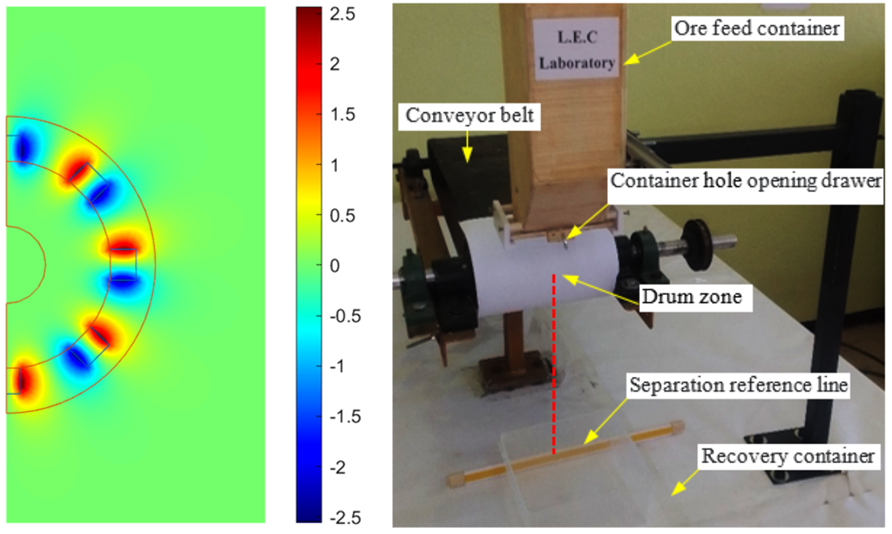
Introduction. Magnetic separation is one of the most effective and widely used techniques for the purification and enrichment of materials. It plays a crucial role in mineral processing, recycling, and environmental applications, where the separation efficiency depends on both the magnetic field characteristics and the physical properties of the treated materials. Problem. A major limitation of existing studies is that the frictional drag force is often neglected in magnetic separation, although it can sometimes completely prevent the separation process. Goal. To estimate and experimentally verify the effect of frictional drag force on the performance and operational limits of open gradient magnetic separation (OGMS) under dry conditions. Methodology. An integrated analytical, numerical, and experimental approach was used. The granular medium was modeled as a complex fluid where friction acted as a drag force. The coupled magnetic and dynamic equations were solved using Finite Element (FE) – Runge–Kutta (RK4) methods, and results were validated experimentally with a permanent magnet drum separator. Results. To verify the obtained results experiments were carried out on samples of a mixture of sand and iron particles with different components sizes (iron particles and sand grains) in a permanent magnet drum separator. Limited to fine granulometries, the experiments carried out confirmed the results obtained theoretically. Scientific novelty. The study introduces a coupled FE–RK4 model that explicitly integrates the frictional drag force into the particle dynamic equations, enabling accurate prediction of trajectories and operational thresholds. This provides a realistic description of dry magnetic separation behavior, which has been largely overlooked in previous models of dry magnetic separation. Practical value. The findings provide engineers with a framework for optimizing dry OGMS performance. The developed model defines the threshold separating efficient from inhibited particle capture and clarifies how frictional drag controls the operational range of magnetic separators. These insights support improved design, process adjustment, and greater reliability in dry magnetic separation. References 41, tables 7, figures 12.
References
Ku J., Wang K., Wang Q., Lei Z. Application of Magnetic Separation Technology in Resource Utilization and Environmental Treatment. Separations, 2024, vol. 11, no. 5, art. no. 130. doi: https://doi.org/10.3390/separations11050130.
Kukkala P.C., Kumar S., Nirala A., Khan M.A., Alkahtani M.Q., Islam S. Beneficiation of Low-Grade Hematite Iron Ore Fines by Magnetizing Roasting and Magnetic Separation. ACS Omega, 2024, vol. 9, no. 7, pp. 7634-7642. doi: https://doi.org/10.1021/acsomega.3c06802.
Fariss A.H.B., Bicalho W.C.S., Seixas L., Faustino L.M. Beneficiation of low-grade iron ore using a dry-roll magnetic separator and its modeling via artificial neural network. Journal of Sustainable Metallurgy, 2025, vol. 11, art. no. 529. doi: https://doi.org/10.1007/s40831-025-01030.
Xie S., Hu Z., Lu D., Zhao Y. Dry Permanent Magnetic Separator: Present Status and Future Prospects. Minerals, 2022, vol. 12, no. 10, art. no. 1251. doi: https://doi.org/10.3390/min12101251.
Jiu S., Zhao B., Yang C., Chen Y., Cheng F. High-Efficiency Iron Extraction from Low-Grade Siderite via a Conveyor Bed Magnetization Roasting–Magnetic Separation Process: Kinetics Research and Applications. Materials, 2022, vol. 15, no. 18, art. no. 6260. doi: https://doi.org/10.3390/ma15186260.
Wang X., Hu Y., Hao Y., Shen Z., Liang G., Zhang M. Simulation of Dynamic Particle Trapping and Accumulation in HGMS Based on FEM-CFD-DEM Coupling Approach. Processes, 2025, vol. 13, no. 8, art. no. 2391. doi: https://doi.org/10.3390/pr13082391.
Liu J., Dai H., Yu L., Wang C., Feng J., Li P., Xu S. Optimization of the Matrix in a Transverse-Field High-Gradient Magnetic Separator for an Improved Ilmenite Separation. Minerals, 2025, vol. 15, no. 2, art. no. 114. doi: https://doi.org/10.3390/min15020114.
Vilakazi A.Q., Shemi A., Ndlovu S. Dry Magnetic Separation and the Leaching Behaviour of Aluminium, Iron, Titanium, and Selected Rare Earth Elements (REEs) from Coal Fly Ash. Minerals, 2025, vol. 15, no. 2, art. no. 119. doi: https://doi.org/10.3390/min15020119.
Chokin K., Yedilbayev A., Yugai V., Medvedev A. Beneficiation of Magnetically Separated Iron-Containing Ore Waste. Processes, 2022, vol. 10, no. 11, art. no. 2212. doi: https://doi.org/10.3390/pr10112212.
Liu J., Xue Z., Dong Z., Yang X., Fu Y., Man X., Lu D. Multiphysics Modeling Simulation and Optimization of Aerodynamic Drum Magnetic Separator. Minerals, 2021, vol. 11, no. 7, art. no. 680. doi: https://doi.org/10.3390/min11070680.
Baawuah E., Kelsey C., Addai-Mensah J., Skinner W. A Novel Pneumatic Planar Magnetic Separator for Magnetite Beneficiation: A Focus on Flowsheet Configuration. Minerals, 2020, vol. 10, no. 9, art. no. 759. doi: https://doi.org/10.3390/min10090759.
Luukkanen S., Tanhua A., Zhang Z., Mollehuara Canales R., Auranen I. Towards waterless operations from mine to mill. Minerals Engineering, 2022, vol. 187, art. no. 107793. doi: https://doi.org/10.1016/j.mineng.2022.107793.
Yi F., Chen L., Liu X., Zeng J., Xue Z. Development of a centrifugal dry magnetic separator for separation of fine magnetite ore. Powder Technology, 2024, vol. 437, art. no. 119557. doi: https://doi.org/10.1016/j.powtec.2024.119557.
Lu D., Liu J., Cheng Z., Li X., Xue Z., Li S., Zheng X., Wang Y. Development of an open-gradient magnetic separator in the aerodynamic field. Physicochemical Problems of Mineral Processing, 2020, vol. 56, no. 2, pp. 325-337. doi: https://doi.org/10.37190/ppmp20005.
Li X., Wang Y., Lu D., Zheng X., Gao X. Optimization of Airflow Field for Pneumatic Drum Magnetic Separator to Improve the Separation Efficiency. Minerals, 2021, vol. 11, no. 11, art. no. 1228. doi: https://doi.org/10.3390/min11111228.
Ouili M., Mehasni R., Feliachi M., Belounis A., Latreche M.E.H. A simultaneous separation of magnetic and conductive particles in a designed permanent magnet drum separator. International Journal of Applied Electromagnetics and Mechanics, 2019, vol. 61, no. 1, pp. 137-155. doi: https://doi.org/10.3233/JAE-180101.
Zeng J., Tong X., Yi F., Chen L. Selective Capture of Magnetic Wires to Particles in High Gradient Magnetic Separation. Minerals, 2019, vol. 9, no. 9, art. no. 509. doi: https://doi.org/10.3390/min9090509.
Belounis A., Mehasni R., Ouili M., Latreche M.E. Optimization of the capture element for an OGMS based on the 3D computation of the magnetic particle behavior. International Journal of Applied Electromagnetics and Mechanics, 2015, vol. 48, no. 4, pp. 387-397. doi: https://doi.org/10.3233/JAE-140157.
Mehasni R., Latreche M., Feliachi M. Fine particles behavior analysis for magnetic separation process. International Journal of Applied Electromagnetics and Mechanics, 2004, vol. 19, no. 1–4, pp. 587-590. doi: https://doi.org/10.3233/JAE-2004-633.
Katsuragi H., Durian D.J. Drag force scaling for penetration into granular media. Physical Review E, 2013, vol. 87, no. 5, art. no. 052208. doi: https://doi.org/10.1103/PhysRevE.87.052208.
Ye X., Wang D., Zhang X., Zhang C., Du W., Su X., Li G. Projectile oblique impact on granular media: penetration depth and dynamic process. Granular Matter, 2021, vol. 23, no. 2, art. no. 48. doi: https://doi.org/10.1007/s10035-021-01108-3.
Omidvar M., Iskander M., Bless S. Response of granular media to rapid penetration. International Journal of Impact Engineering, 2014, vol. 66, pp. 60-82. doi: https://doi.org/10.1016/j.ijimpeng.2013.12.004.
Pol A., Storti S., Gabrieli F. Granular drag and lift force on a flexible fiber. Physical Review E, 2025, vol. 112, no. 4, art. no. 045425. doi: https://doi.org/10.1103/p2db-yt7h.
Brzinski T.A., Mayor P., Durian D.J. Depth-Dependent Resistance of Granular Media to Vertical Penetration. Physical Review Letters, 2013, vol. 111, no. 16, art. no. 168002. doi: https://doi.org/10.1103/PhysRevLett.111.168002.
Marghitu D., Lee S., Marghitu D. Experimental and Simulation Results for the Impact of a Rotating Flexible Link with a Granular Material. International Journal of Advanced Robotic Systems, 2014, vol. 11, no. 1, art. no. 40. doi: https://doi.org/10.5772/58254.
Zhang C., Ye X. Force and flow characteristics of an intruder immersed in 3D dense granular matter. Particuology, 2022, vol. 71, pp. 47-55. doi: https://doi.org/10.1016/j.partic.2022.01.007.
Katsuragi H., Durian D.J. Unified force law for granular impact cratering. Nature Physics, 2007, vol. 3, no. 6, pp. 420-423. doi: https://doi.org/10.1038/nphys583.
Wang F., Chen Y., Li Y., Li Y. A Drag Force Model of Vertical Penetration into a Granular Medium Based on DEM Simulations and Experiments. Applied Sciences, 2024, vol. 14, no. 6, art. no. 2336. doi: https://doi.org/10.3390/app14062336.
Zaidi A.A. Numerical investigation of drag force on a spherical intruder by granular material. Powder Technology, 2023, vol. 427, art. no. 118765. doi: https://doi.org/10.1016/j.powtec.2023.118765.
Dodds D., Sarhan A.R., Naser J. Experimental and numerical study of drag forces on particles in clusters. Powder Technology, 2020, vol. 371, pp. 195-208. doi: https://doi.org/10.1016/j.powtec.2020.05.082.
Zaidi A.A. Granular drag force during immersion in dry quicksand. Powder Technology, 2020, vol. 364, pp. 986-993. doi: https://doi.org/10.1016/j.powtec.2019.10.048.
Lavinsky D.V., Zaitsev Y.I. Computational studies of electromagnetic field propagation and deforming of structural elements for a thin-walled curved workpiece and an inductor. Electrical Engineering & Electromechanics, 2024, no. 2, pp. 55-60. doi: https://doi.org/10.20998/2074-272X.2024.2.08.
Gans Š., Molnár J., Kováč D. Estimation of electrical resistivity of conductive materials of random shapes. Electrical Engineering & Electromechanics, 2023, no. 6, pp. 72-76. doi: https://doi.org/10.20998/2074-272X.2023.6.13.
Ouili M., Mehasni R., Feliachi M., Latreche M.E.H. Coupling of PSO and FE methods for electrical conductivity identification of materials used in eddy current separator. International Journal of Applied Electromagnetics and Mechanics, 2023, vol. 72, no. 2, pp. 103-114. doi: https://doi.org/10.3233/JAE-220248.
Yang Y., Robertson W.S.P., Jafari A., Arjomandi M. Advanced Numerical Approaches for Magnetic Force Calculations: A Comprehensive Review. Progress In Electromagnetics Research B, 2025, vol. 115, pp. 78-94. doi: https://doi.org/10.2528/PIERB25071902.
Bastos J.P.A., Sadowski N. Electromagnetic Modeling by Finite Element Methods. CRC Press, 2003. 510 p. doi: https://doi.org/10.1201/9780203911174.
Tolmachev S.T., Bondarevskyi S.L., Il’chenko A.V. Magnetic properties of multicomponent heterogeneous media with a doubly periodic structure. Electrical Engineering & Electromechanics, 2020, no. 1, pp. 29-38. doi: https://doi.org/10.20998/2074-272X.2020.1.05.
Milykh V.I., Tymin M.G. A comparative analysis of the parameters of a rotating magnetic field inductor when using concentric and loop windings. Electrical Engineering & Electromechanics, 2021, no. 4, pp. 12-18. doi: https://doi.org/10.20998/2074-272X.2021.4.02.
Grechko O.M. Influence of the poles shape of DC electromagnetic actuator on its thrust characteristic. Technical Electrodynamics, 2024, no. 1, pp. 38-45. doi: https://doi.org/10.15407/techned2024.01.038.
Lohse D., Rauhe R., Bergmann R., Van der Meer D. Creating a dry variety of quicksand. Nature, 2004, vol. 432, no. 7018, pp. 689-690. doi: https://doi.org/10.1038/432689a.
Mehasni R., Feliachi M., Latreche M.E.H. Effect of the Magnetic Dipole–Dipole Interaction on the Capture Efficiency in Open Gradient Magnetic Separation. IEEE Transactions on Magnetics, 2007, vol. 43, no. 8, pp. 3488-3493. doi: https://doi.org/10.1109/TMAG.2007.897616.
Downloads
Published
How to Cite
Issue
Section
License
Copyright (c) 2026 O. Belguet, R. Mehasni, A. Belounis, M. Ouili

This work is licensed under a Creative Commons Attribution-NonCommercial 4.0 International License.
Authors who publish with this journal agree to the following terms:
1. Authors retain copyright and grant the journal right of first publication with the work simultaneously licensed under a Creative Commons Attribution License that allows others to share the work with an acknowledgement of the work's authorship and initial publication in this journal.
2. Authors are able to enter into separate, additional contractual arrangements for the non-exclusive distribution of the journal's published version of the work (e.g., post it to an institutional repository or publish it in a book), with an acknowledgement of its initial publication in this journal.
3. Authors are permitted and encouraged to post their work online (e.g., in institutional repositories or on their website) prior to and during the submission process, as it can lead to productive exchanges, as well as earlier and greater citation of published work.