Analysis of the external network parameters influence on the operating characteristics of self-excited induction generators
DOI:
https://doi.org/10.20998/2074-272X.2026.3.02Keywords:
self-excited induction generator, voltage stability, current distortion, reliability enhancement, rotor, capacitorAbstract
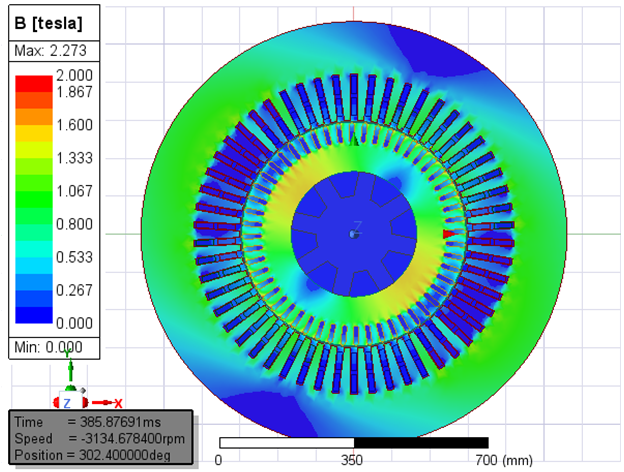
Introduction. Self-excited induction generators (SEIGs) play a vital role in renewable energy systems, particularly in remote regions. However, their performance is highly sensitive to excitation capacitance, rotor speed and load variations, making stability and reliability key challenges. Problem. Simplified analytical models fail to capture the complex internal interactions within SEIGs, limiting the analysis of how external network variations influence their dynamics. Moreover, the gradual degradation of excitation capacitors, a common fault in practice, significantly reduces generator efficiency. The goal of this work is to analyze the influence of excitation capacitance, rotor speed and load variations on SEIG performance, focusing on gradual capacitor degradation and open-phase faults to provide guidelines for reliable and efficient design. Methodology. Finite element modeling (FEM) with ANSYS Maxwell is used to accurately simulate electromagnetic and mechanical dynamics under realistic operating conditions. Results. Simulations show how changes in capacitance, rotor speed and load greatly affect voltage and current stability. Capacitor faults and open-phase conditions cause current distortion, voltage unbalance and reduced efficiency. Scientific novelty of this work lies in the FEM-based analysis of gradual excitation capacitor degradation in SEIGs. It was determined that this degradation directly impacts voltage balance, current waveform distortion and overall efficiency. Practical value. The findings provide clear guidelines for selecting optimal excitation capacitance and load ranges, reducing costs while enhancing the reliability and efficiency of SEIGs, particularly in isolated regions. Also this study offers new physical insight and a reliable framework for generator condition monitoring and design optimization. References 24, tables 1, figures 12.
References
Hafaiedh H., Saoudi Y., Benamor A., Chrifi–Alaoui L. Wind farms integration into power system with improved location and stability problem solving. Electrical Engineering & Electromechanics, 2025, no. 5, pp. 10-16. doi: https://doi.org/10.20998/2074-272X.2025.5.02.
Belynda F., Abdelli R., Bouzida A. Stator current signal crossing for fault diagnosis of self-excited induction generators. Acta Polytechnica, 2023, vol. 64, no. 5, pp. 293-304. doi: https://doi.org/10.14311/AP.2023.63.0293.
Shailly D., Chittora P., Singh M. Performance analysis of multiple delayed signal cancellation (MDSC) for power quality improvement for fixed speed SEIG-based distributed generation. Electrical Engineering, 2025, vol. 107, no. 8, pp. 10911-10930. doi: https://doi.org/10.1007/s00202-025-03068-w.
Kouchih D., Hachelaf R. Discrimination of Stator Asymmetries and Magnetic Saturation in Self-Excited Induction Generators. Russian Electrical Engineering, 2024, vol. 95, no. 5, pp. 417-424. doi: https://doi.org/10.3103/S1068371224700469.
Khan M.F., Khan M.R., Iqbal A. Effects of induction machine parameters on its performance as a standalone self excited induction generator. Energy Reports, 2022, vol. 8, pp. 2302-2313. doi: https://doi.org/10.1016/j.egyr.2022.01.023.
Catelas J.M.R., Fernandes J.F.P., Pérez-Sánchez M., López-Jiménez P.A., Ramos H.M., Branco P.J.C. Energy Efficiency and Stability of Micro-Hydropower PAT-SEIG Systems for DC Off-Grids. Energies, 2024, vol. 17, no. 6, art. no. 1382. doi: https://doi.org/10.3390/en17061382.
Ahmed M.M., Hassanein W.S., Enany M.A. Proposing and Evaluation of SC Techniques for Variable Speed High-Power Operation of SEIG. IEEE Access, 2020, vol. 8, pp. 20666-20675. doi: https://doi.org/10.1109/ACCESS.2020.2968976.
Singh G., Singh V.R. SEIG-based transient- and steady-state analysis using dragon fly approach. Soft Computing, 2023, vol. 27, no. 6, pp. 2993-3005. doi: https://doi.org/10.1007/s00500-022-07458-1.
Rajak M.K., Samanta J., Pudur R. A hardware-based novel approach for parallel operation of two differently rated SEIGs. Results in Engineering, 2023, vol. 17, art. no. 100825. doi: https://doi.org/10.1016/j.rineng.2022.100825.
Murali Krishna V.B., Sandeep V., Murthy S.S., Yadlapati K. Experimental investigation on performance comparison of self excited induction generator and permanent magnet synchronous generator for small scale renewable energy applications. Renewable Energy, 2022, vol. 195, pp. 431-441. doi: https://doi.org/10.1016/j.renene.2022.06.051.
Dewangan S., Vadhera S. Performance Evaluation of Multilevel Inverter in Variable Speed SEIG-Based Wind Energy System. Arabian Journal for Science and Engineering, 2022, vol. 47, no. 3, pp. 3311-3324. doi: https://doi.org/10.1007/s13369-021-06197-z.
Chanu L.K., Chakraborty S., Pudur R. Real-time analysis of voltage and frequency regulation of self-excited induction generator based micro hydro plant using generalized impedance controller. Measurement: Sensors, 2024, vol. 33, art. no. 101235. doi: https://doi.org/10.1016/j.measen.2024.101235.
Özer A.S., Sevilmiş F., Karaca H., Arabacı H. Enhanced control method for voltage regulation of DSTATCOM based SEIG. Energy Reports, 2022, vol. 8, pp. 839-847. doi: https://doi.org/10.1016/j.egyr.2022.05.191.
Dalei J., Mohanty K.B. Fault classification in SEIG system using Hilbert-Huang transform and least square support vector machine. International Journal of Electrical Power & Energy Systems, 2016, vol. 76, pp. 11-22. doi: https://doi.org/10.1016/j.ijepes.2015.09.009.
Patel A.N., Doshi P.J., Mahagoakar S.C., Panchal T.H. Optimization of cogging torque in interior permanent magnet synchronous motor using optimum magnet v-angle. Electrical Engineering & Electromechanics, 2023, no. 6, pp. 16-20. doi: https://doi.org/10.20998/2074-272X.2023.6.03.
Panchal T.H., Patel A.N., Patel R.M. Reduction of cogging torque of radial flux permanent magnet brushless DC motor by magnet shifting technique. Electrical Engineering & Electromechanics, 2022, no. 3, pp. 15-20. doi: https://doi.org/10.20998/2074-272X.2022.3.03.
Iegorov O.B., Kundenko M.P., Iegorova O.Y., Mardziavko V.A., Rudenko A.Y. The influence of the design of the stator winding of a synchronous-reactive generator on increasing its energy efficiency. Electrical Engineering & Electromechanics, 2025, no. 5, pp. 3-9. doi: https://doi.org/10.20998/2074-272X.2025.5.01.
Grechko O.M. Influence of the poles shape of DC electromagnetic actuator on its thrust characteristic. Technical Electrodynamics, 2024, no. 1, pp. 38-45. doi: https://doi.org/10.15407/techned2024.01.038.
Arya S.R., Maurya R., Giri A.K., Qureshi A., Baladhanautham C.B. Power quality solutions for effective utilization of single-phase induction generator using voltage source converter. Energy Sources, Part A: Recovery, Utilization, and Environmental Effects, 2025, vol. 47, no. 2, art. no. 1772414. doi: https://doi.org/10.1080/15567036.2020.1772414.
Samanta J., Chakraborty S., Sangno R., Pudur R. Study of power quality issues in a renewable-driven self-excited induction generator due to different loads at edge-off grid system. E-Prime - Advances in Electrical Engineering, Electronics and Energy, 2025, no. 11, art. no. 100885. doi: https://doi.org/10.1016/j.prime.2024.100885.
Abd el-Ghany H.A., Ahmed E.S., ELGebaly A.E. A Reliable Loss of Excitation Protection Technique Based on EPFA for Synchronous Generators. IEEE Transactions on Power Delivery, 2022, vol. 37, no. 3, pp. 1445-1455. doi: https://doi.org/10.1109/TPWRD.2021.3087538.
Paliwal S., Sinha S.K., Chauhan Y.K. Frequency Control of 5 kW Self-excited Induction Generator Using Gravitational Search Algorithm and Genetic Algorithm. AI and IOT in Renewable Energy, 2021, pp. 75-88. doi: https://doi.org/10.1007/978-981-16-1011-0_8.
Sakkoury K.S., Emara S., Ahmed M.K. Analysis of wind driven self-excited induction generator supplying isolated DC loads. Journal of Electrical Systems and Information Technology, 2017, vol. 4, no. 1, pp. 257-268. doi: https://doi.org/10.1016/j.jesit.2016.08.003.
Guan B., Zhen X. Noninvasive Online Capacitor Monitoring Method for Three-Level Converter Based on Active Neutral-Point Current Adjustment. IEEE Transactions on Industrial Electronics, 2024, vol. 71, no. 5, pp. 4320-4329. doi: https://doi.org/10.1109/TIE.2023.3283714.
Downloads
Published
How to Cite
Issue
Section
License
Copyright (c) 2026 A. Dilmi, A. Bouzida, N. Yassa, B. Fares

This work is licensed under a Creative Commons Attribution-NonCommercial 4.0 International License.
Authors who publish with this journal agree to the following terms:
1. Authors retain copyright and grant the journal right of first publication with the work simultaneously licensed under a Creative Commons Attribution License that allows others to share the work with an acknowledgement of the work's authorship and initial publication in this journal.
2. Authors are able to enter into separate, additional contractual arrangements for the non-exclusive distribution of the journal's published version of the work (e.g., post it to an institutional repository or publish it in a book), with an acknowledgement of its initial publication in this journal.
3. Authors are permitted and encouraged to post their work online (e.g., in institutional repositories or on their website) prior to and during the submission process, as it can lead to productive exchanges, as well as earlier and greater citation of published work.