Comprehensive modeling of grid-connected inverters in weak grid systems
DOI:
https://doi.org/10.20998/2074-272X.2026.3.06Keywords:
grid-connected inverter, weak grid, state-space model, small-signal analysis, phase locked loop, renewable energyAbstract
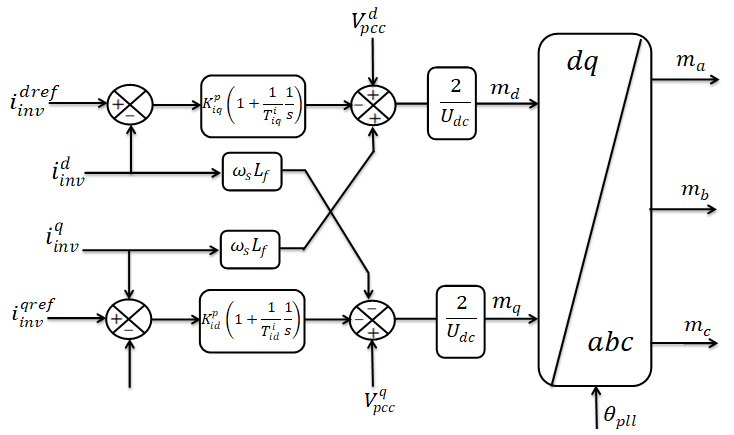
Introduction. The stability of grid-connected inverters is critical for the integration of renewable energy into modern power systems. However, this stability is significantly challenged under weak grid conditions, characterized by high impedance and low short-circuit ratios. Problem. Under such conditions, complex dynamic interactions arise between the inverter control systems, the grid, and the phase-locked loop, which is essential for synchronization. These interactions can degrade phase tracking and even lead to system instability. Such complexities render traditional models inadequate for accurately evaluating system behavior or guiding robust control design. The goal of this work is to develop and validate a compact, linearized state-space model of a grid-connected inverter under weak grid conditions, enabling stability analysis and supporting the design of robust control strategies. Methodology. Using small-signal modeling, a state-space representation of the inverter system is derived, incorporating control dynamics, grid impedance, and the power converter. The model’s accuracy is validated through detailed nonlinear simulations, ensuring strong consistency between both modeling approaches. Results. The proposed model effectively captures the interaction between inverter dynamics and weak grid characteristics. Simulation results demonstrate a high correlation with nonlinear behavior, confirming the model’s validity. Scientific novelty. Unlike existing models, this unified linearized state-space model explicitly captures cross-coupling effects among control loops and grid dynamics under weak grid scenarios. It enables more accurate stability analysis and provides deeper insights into the system’s dynamic behavior. Practical value. The model serves as a practical tool for engineers designing control systems for renewable energy integration. By enhancing controller robustness, it contributes to more stable and reliable power systems in weak grid environments. References 22, tables 2, figures 6.
References
Janardhan G., Surendra Babu N.N.V., Srinivas G.N. Single phase transformerless inverter for grid connected photovoltaic system with reduced leakage current. Electrical Engineering & Electromechanics, 2022, no. 5, pp. 36-40. doi: https://doi.org/10.20998/2074-272X.2022.5.06.
Boukadoum A., Bouguerne A., Bahi T. Direct power control using space vector modulation strategy control for wind energy conversion system using three-phase matrix converter. Electrical Engineering & Electromechanics, 2023, no. 3, pp. 40-46. doi: https://doi.org/10.20998/2074-272X.2023.3.06.
Xie J. Application of optimized photovoltaic grid-connected control system based on modular multilevel converters. Energy Informatics, 2024, vol. 7, no. 1, art. no. 24. doi: https://doi.org/10.1186/s42162-024-00317-3.
Bennia I., Daili Y., Harrag A., Alrajhi H., Saim A., Guerrero J.M. Stability and Reactive Power Sharing Enhancement in Islanded Microgrid via Small-Signal Modeling and Optimal Virtual Impedance Control. International Transactions on Electrical Energy Systems, 2024, vol. 2024, art. no. 5469868. doi: https://doi.org/10.1155/2024/5469868.
Ji X., Liu D., Jiang K., Zhang Z., Yang Y. Small-Signal Stability of Hybrid Inverters with Grid-Following and Grid-Forming Controls. Energies, 2024, vol. 17, no. 7, art. no. 1644. doi: https://doi.org/10.3390/en17071644.
Muthukaruppasamy S., Dharmaprakash R., Sendilkumar S., Parimalasundar E. Enhancing off-grid wind energy systems with controlled inverter integration for improved power quality. Electrical Engineering & Electromechanics, 2024, no. 5, pp. 41-47. doi: https://doi.org/10.20998/2074-272X.2024.5.06.
Wang X., Yao J., Pei J., Sun P., Zhang H., Liu R. Analysis and Damping Control of Small-Signal Oscillations for VSC Connected to Weak AC Grid During LVRT. IEEE Transactions on Energy Conversion, 2019, vol. 34, no. 3, pp. 1667-1676. doi: https://doi.org/10.1109/TEC.2019.2915680.
Zheng Y., Han Y., Wang C., Ren Q., Yang P., Zalhaf A.S. Impact of phase-locked loop on grid-connected inverter stability under weak grid conditions and suppression measures. Computers and Electrical Engineering, 2025, vol. 123, art. no. 110249. doi: https://doi.org/10.1016/j.compeleceng.2025.110249.
Tamari Y., Kato T., Inoue K. Stability Analysis Considering PLL Effects for Grid-Following Inverter by Complex Vector Control. IEEJ Transactions on Electronics, Information and Systems, 2024, vol. 144, no. 11, pp. 1044-1051. doi: https://doi.org/10.1541/ieejeiss.144.1044.
Liu A., Cao H., Liu J. Enhancing stability control of Phase-Locked loop in weak power grids. International Journal of Electrical Power & Energy Systems, 2024, vol. 161, art. no. 110145. doi: https://doi.org/10.1016/j.ijepes.2024.110145.
Zhang Y., Pen H., Zhang X. Stability Control of Grid-Connected Converter Considering Phase-Locked Loop Frequency Coupling Effect. Energies, 2024, vol. 17, no. 14, art. no. 3438. doi: https://doi.org/10.3390/en17143438.
Yue J., Gao J., An R., Jin L., Tao R., Zou K. A Method for Improving the Stability of Grid-Connected Inverters by Eliminating the Negative Effects of PLL in Weak Grids. 2022 4th International Conference on Power and Energy Technology (ICPET), 2022, pp. 299-304. doi: https://doi.org/10.1109/ICPET55165.2022.9918343.
Lin X., Chih-Hsien Peng J., Macii D., Petri D., Yu J., Wen H. Frequency-domain small-signal stability analysis methods for grid-following converters systems – An overview. Renewable and Sustainable Energy Reviews, 2025, vol. 211, art. no. 115283. doi: https://doi.org/10.1016/j.rser.2024.115283.
Pathan E., Zulkifli S.A., Tayab U.B., Jackson R. Small Signal Modeling of Inverter-based Grid-Connected Microgrid to Determine the Zero-Pole Drift Control with Dynamic Power Sharing Controller. Engineering, Technology & Applied Science Research, 2019, vol. 9, no. 1, pp. 3790-3795. doi: https://doi.org/10.48084/etasr.2465.
Zou Z.-X., Rosso R., Liserre M. Modeling of the Phase Detector of a Synchronous-Reference-Frame Phase-Locked Loop Based on Second-Order Approximation. IEEE Journal of Emerging and Selected Topics in Power Electronics, 2020, vol. 8, no. 3, pp. 2534-2545. doi: https://doi.org/10.1109/JESTPE.2019.2920309.
Pérez-Estévez D., Ríos-Castro D., Fernández-Abraldes P.M., Monteiro V., Pinto J.G., Afonso J.L., Doval-Gandoy J. Asymmetric Impedance Model for Grid-Forming Converters With Droop Control. IEEE Transactions on Power Electronics, 2025, vol. 40, no. 9, pp. 12977-12997. doi: https://doi.org/10.1109/TPEL.2025.3565789.
Golestan S., Ebrahimzadeh E., Wen B., Guerrero J.M., Vasquez J.C. dq-Frame Impedance Modeling of Three-Phase Grid-Tied Voltage Source Converters Equipped With Advanced PLLs. IEEE Transactions on Power Electronics, 2021, vol. 36, no. 3, pp. 3524-3539. doi: https://doi.org/10.1109/TPEL.2020.3017387.
Lu S., Zhu Y., Dong L., Na G., Hao Y., Zhang G., Zhang W., Cheng S., Yang J., Sui Y. Small-Signal Stability Research of Grid-Connected Virtual Synchronous Generators. Energies, 2022, vol. 15, no. 19, art. no. 7158. doi: https://doi.org/10.3390/en15197158.
Fang L., Feng L., Chu C., Xu J., Wu R., Fan Q. Evaluation of dominant factors for stability of grid‐connected inverters based on impedance sensitivity analysis. IET Renewable Power Generation, 2024, vol. 18, no. 16, pp. 3788-3797. doi: https://doi.org/10.1049/rpg2.13020.
Gassara K., Gassara B., Fakhfakh A., De Pablo S. Offline Analysis of a Modified dqPLL Architecture based on THD Compensation Blocks for Three-Phase Grid-Tied Inverters. Engineering, Technology & Applied Science Research, 2025, vol. 15, no. 3, pp. 22669-22677. doi: https://doi.org/10.48084/etasr.10206.
Pal D., Panigrahi B.K. A Nonlinear Adaptive Stabilizing Control Strategy to Enhance Dynamic Stability of Weak Grid-Tied VSC System. IEEE Transactions on Power Delivery, 2022, vol. 37, no. 3, pp. 2182-2193. doi: https://doi.org/10.1109/TPWRD.2021.3106682.
Zerzouri N., Ben Si Ali N., Benalia N. A maximum power point tracking of a photovoltaic system connected to a three-phase grid using a variable step size perturb and observe algorithm. Electrical Engineering & Electromechanics, 2023, no. 5, pp. 37-46. doi: https://doi.org/10.20998/2074-272X.2023.5.06.
Downloads
Published
How to Cite
Issue
Section
License
Copyright (c) 2026 Y. Daili, R. Bentafer, N. Djaraf, A. Harrag

This work is licensed under a Creative Commons Attribution-NonCommercial 4.0 International License.
Authors who publish with this journal agree to the following terms:
1. Authors retain copyright and grant the journal right of first publication with the work simultaneously licensed under a Creative Commons Attribution License that allows others to share the work with an acknowledgement of the work's authorship and initial publication in this journal.
2. Authors are able to enter into separate, additional contractual arrangements for the non-exclusive distribution of the journal's published version of the work (e.g., post it to an institutional repository or publish it in a book), with an acknowledgement of its initial publication in this journal.
3. Authors are permitted and encouraged to post their work online (e.g., in institutional repositories or on their website) prior to and during the submission process, as it can lead to productive exchanges, as well as earlier and greater citation of published work.