Enhanced power quality in grid-connected wind energy systems using PI-controlled with doubly fed induction generator optimized by hybrid differential evolution and grey wolf algorithm
DOI:
https://doi.org/10.20998/2074-272X.2026.3.05Keywords:
doubly fed induction generator, wind power, differential evolution, power quality, total harmonic distortionAbstract
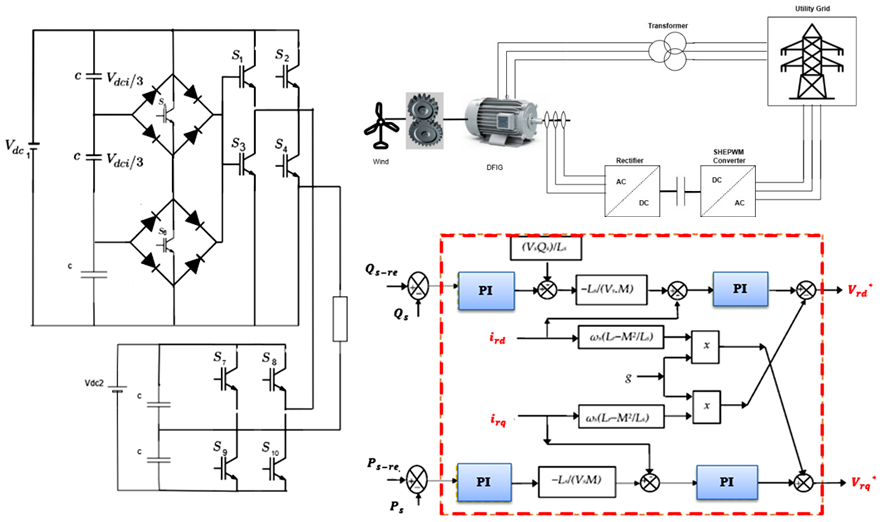
Introduction. Nowadays, the most widely used wind energy conversion system in wind farms is based on a doubly fed induction generator (DFIG); it has a large speed range and can function in multiple modes. Problem. Harmonic distortion in wind energy conversion system can degrade output waveform quality, reduce power conversion efficiency. Goal. This study investigates the dynamic performance of a wind energy conversion system comprising a grid-connected load, a 13-level hybrid multilevel converter and a doubly fed induction generator (DFIG), using a PI controller. The study aims to evaluate the dynamic performance and power quality of wind energy conversion systems, and to develop a novel hybrid metaheuristic method combining differential evolution (DE) and grey wolf optimization (GWO)-based selective harmonic elimination pulse-width modulation (SHEPWM) control strategies. This method reduces total harmonic distortion (THD) and ensures compliance with IEEE 519 standards, while increasing the power transferred to the grid. Methodology. The system, which includes a grid-connected load, a 13-level converter, and a DFIG, is modeled and simulated in MATLAB/Simulink under steady-state wind conditions. Vector control via stator flow orientation was used to modify the energy quality provided by the DFIG, making the system comparable to the DC machine. Our approach was to use a PI controller in order to directly control the active and reactive DFIG power through multi-level converter then a hybrid metaheuristic algorithm combining DE and GWO is implemented to solve the SHEPWM nonlinear transcendental equations. The proposed algorithm is evaluated based on its ability to suppress lower-order harmonics and improve THD performance, these converters increase the power transmitted to the power grid by reducing harmonic content of the output voltages. Results. By using the DE-GWO hybrid method and a PI controller, lower-order harmonics were effectively removed and THD was reduced to meet IEEE 519 standards. Simulations showed an improvement in output wave quality and better energy conversion efficiency compared to conventional optimization methods. Scientific novelty of the proposed work lies in the fact that the study introduces a novel DE-GWO hybrid optimization method for PWM (SHEPWM) in 13-level hybrid multilevel converter applied to wind energy systems. Practical value. The novel method demonstrates that constant high performance in wind energy systems may be achieved by combining intelligent optimization algorithms with complex multilevel converter designs This means it can be effectively integrated into contemporary wind farms where meeting grid standards, adjusting to varying sizes, and ensuring long-term reliability are crucial. References 26, table 1, figures 19.
References
Tamalouzt S., Benyahia N., Rekioua T., Rekioua D., Abdessemed R. Performances analysis of WT-DFIG with PV and fuel cell hybrid power sources system associated with hydrogen storage hybrid energy system. International Journal of Hydrogen Energy, 2016, vol. 41, no. 45, pp. 21006-21021. doi: https://doi.org/10.1016/j.ijhydene.2016.06.163.
Shihabudheen K.V., Pillai G.N., Krishnama Raju S. Neuro-Fuzzy Control of DFIG Wind Energy System with Distribution Network. Electric Power Components and Systems, 2018, vol. 46, no. 13, pp. 1416-1431. doi: https://doi.org/10.1080/15325008.2018.1499154.
Jaladi K.K., Sandhu K.S. Real-time simulator based hybrid controller of DFIG-WES during grid faults design and analysis. International Journal of Electrical Power & Energy Systems, 2020, vol. 116, art. no. 105545. doi: https://doi.org/10.1016/j.ijepes.2019.105545.
Hafaiedh H., Saoudi Y., Benamor A., Chrifi–Alaoui L. Wind farms integration into power system with improved location and stability problem solving. Electrical Engineering & Electromechanics, 2025, no. 5, pp. 10-16. doi: https://doi.org/10.20998/2074-272X.2025.5.02.
Parimalasundar E., Jayanthi R., Suresh K., Sindhuja R. Investigation of efficient multilevel inverter for photovoltaic energy system and electric vehicle applications. Electrical Engineering & Electromechanics, 2023, no. 4, pp. 47-51. doi: https://doi.org/10.20998/2074-272X.2023.4.07.
Gianto R. Steady‐state model of DFIG‐based wind power plant for load flow analysis. IET Renewable Power Generation, 2021, vol. 15, no. 8, pp. 1724-1735. doi: https://doi.org/10.1049/rpg2.12141.
Li S., Li L. Steady-state Solution and Evaluation Indices of DFIG Operating at Synchronous Speed (sDFIG). 2021 IEEE Sustainable Power and Energy Conference (ISPEC), 2021, pp. 260-267. doi: https://doi.org/10.1109/iSPEC53008.2021.9736024.
Tamalouzt S., Belkhier Y., Sahri Y., Bajaj M., Ullah N., Chowdhury M.S., Titseesang T., Techato K. Enhanced Direct Reactive Power Control-Based Multi-Level Inverter for DFIG Wind System under Variable Speeds. Sustainability, 2021, vol. 13, no. 16, art. no. 9060. doi: https://doi.org/10.3390/su13169060.
Padmanaban S., Dhanamjayulu C., Khan B. Artificial Neural Network and Newton Raphson (ANN-NR) Algorithm Based Selective Harmonic Elimination in Cascaded Multilevel Inverter for PV Applications. IEEE Access, 2021, vol. 9, pp. 75058-75070. doi: https://doi.org/10.1109/ACCESS.2021.3081460.
Sifat Z., Hussain M.T., Khan M.A., Hussain M.S., Sarwar A., Tariq M., Hasan M. Selective harmonic elimination in PUC‐5 multilevel inverter using hybrid IGWO‐DE algorithm. Engineering Reports, 2024, vol. 6, no. 10, art. no. e12883. doi: https://doi.org/10.1002/eng2.12883.
Dahidah M.S.A., Konstantinou G., Agelidis V.G. A Review of Multilevel Selective Harmonic Elimination PWM: Formulations, Solving Algorithms, Implementation and Applications. IEEE Transactions on Power Electronics, 2015, vol. 30, no. 8, pp. 4091-4106. doi: https://doi.org/10.1109/TPEL.2014.2355226.
Bektas E., Karaca H. GA Based Selective Harmonic Elimination for Multilevel Inverter with Reduced Number of Switches: An Experimental Study. Elektronika Ir Elektrotechnika, 2019, vol. 25, no. 3, pp. 10-17. doi: https://doi.org/10.5755/j01.eie.25.3.23670.
Kumar S.S., Iruthayarajan M.W., Sivakumar T. Evolutionary algorithm based selective harmonic elimination for three-phase cascaded H-bridge multilevel inverters with optimized input sources. Journal of Power Electronics, 2020, vol. 20, no. 5, pp. 1172-1183. doi: https://doi.org/10.1007/s43236-020-00112-9.
Kala P., Arora S. Implementation of PSO based Selective Harmonic Elimination Technique in Multilevel Inverters. 2018 2nd IEEE International Conference on Power Electronics, Intelligent Control and Energy Systems (ICPEICES), 2018, pp. 605-610. doi: https://doi.org/10.1109/ICPEICES.2018.8897309.
Ceylan O., Neshat M., Mirjalili S. Cascaded H-bridge multilevel inverters optimization using adaptive grey wolf optimizer with local search. Electrical Engineering, 2024, vol. 106, no. 2, pp. 1765-1779. doi: https://doi.org/10.1007/s00202-021-01441-z.
Nasser A.M., Refky A., Shatla H., Abdel-hamed A.M. A grey wolf optimization-based modified SPWM control scheme for a three-phase half bridge cascaded multilevel inverter. Scientific Reports, 2024, vol. 14, no. 1, art. no. 7016. doi: https://doi.org/10.1038/s41598-024-57262-0.
Stonier A.A., Chinnaraj G., Kannan R., Mani G. Investigation and validation of an eleven level symmetric modular multilevel inverter using grey wolf optimization and differential evolution control algorithm for solar PV applications. Circuit World, 2020, vol. 47, no. 1, pp. 117-127. doi: https://doi.org/10.1108/CW-12-2019-0197.
Mirjalili S., Mirjalili S.M., Lewis A. Grey Wolf Optimizer. Advances in Engineering Software, 2014, vol. 69, pp. 46-61. doi: https://doi.org/10.1016/j.advengsoft.2013.12.007.
Djebbar M.S., Boukadoum A., Bouguerne A. Performances of a wind power system based on the doubly fed induction generator controlled by a multi-level inverter. International Journal of Power Electronics and Drive Systems (IJPEDS), 2023, vol. 14, no. 1, pp. 100-110. doi: https://doi.org/10.11591/ijpeds.v14.i1.pp100-110.
Sayeh K.F., Tamalouzt S., Sahri Y. Improvement of power quality in WT-DFIG systems using novel direct power control based on fuzzy logic control under randomness conditions. International Journal of Modelling and Simulation, 2025, vol. 45, no. 1, pp. 55-67. doi: https://doi.org/10.1080/02286203.2023.2270757.
Kaddache M., Drid S., Khemis A., Rahem D., Chrifi-Alaoui L. Maximum power point tracking improvement using type-2 fuzzy controller for wind system based on the double fed induction generator. Electrical Engineering & Electromechanics, 2024, no. 2, pp. 61-66. doi: https://doi.org/10.20998/2074-272X.2024.2.09.
Kumar Behara R., Kumar Saha A. Deep Q-Network Reinforcement Learning-Based Rotor Side Control System of a Grid Integrated DFIG Wind Energy System Under Variable Wind Speed Conditions. IEEE Access, 2024, vol. 12, pp. 184179-184205. doi: https://doi.org/10.1109/ACCESS.2024.3511665.
Benbouhenni H., Yessef M., Colak I., Bizon N., Kotb H., AboRas K.M., ELrashidi A. Dynamic performance of rotor-side nonlinear control technique for doubly-fed multi-rotor wind energy based on improved super-twisting algorithms under variable wind speed. Scientific Reports, 2024, vol. 14, no. 1, art. no. 5664. doi: https://doi.org/10.1038/s41598-024-55271-7.
Muthukaruppasamy S., Dharmaprakash R., Sendilkumar S., Parimalasundar E. Enhancing off-grid wind energy systems with controlled inverter integration for improved power quality. Electrical Engineering & Electromechanics, 2024, no. 5, pp. 41-47. doi: https://doi.org/10.20998/2074-272X.2024.5.06.
L’Hadj Said M., Ali Moussa M., Bessaad T. Control of an autonomous wind energy conversion system based on doubly fed induction generator supplying a non-linear load. Electrical Engineering & Electromechanics, 2025, no. 4, pp. 3-10. doi: https://doi.org/10.20998/2074-272X.2025.4.01.
Alnaib I.I., Alsammak A.N. Optimization of fractional PI controller parameters for enhanced induction motor speed control via indirect field-oriented control. Electrical Engineering & Electromechanics, 2025, no. 1, pp. 3-7. doi: https://doi.org/10.20998/2074-272X.2025.1.01.
Downloads
Published
How to Cite
Issue
Section
License
Copyright (c) 2026 R. F. Abdelgoui, R. Taleb

This work is licensed under a Creative Commons Attribution-NonCommercial 4.0 International License.
Authors who publish with this journal agree to the following terms:
1. Authors retain copyright and grant the journal right of first publication with the work simultaneously licensed under a Creative Commons Attribution License that allows others to share the work with an acknowledgement of the work's authorship and initial publication in this journal.
2. Authors are able to enter into separate, additional contractual arrangements for the non-exclusive distribution of the journal's published version of the work (e.g., post it to an institutional repository or publish it in a book), with an acknowledgement of its initial publication in this journal.
3. Authors are permitted and encouraged to post their work online (e.g., in institutional repositories or on their website) prior to and during the submission process, as it can lead to productive exchanges, as well as earlier and greater citation of published work.