A new stator flow-oriented control method based on type-2 fuzzy logic controllers for permanent magnet synchronous motors
DOI:
https://doi.org/10.20998/2074-272X.2026.3.10Keywords:
mechanical power control, permanent magnet synchronous motor, stator flow-oriented control, type-2 fuzzy logic controlAbstract
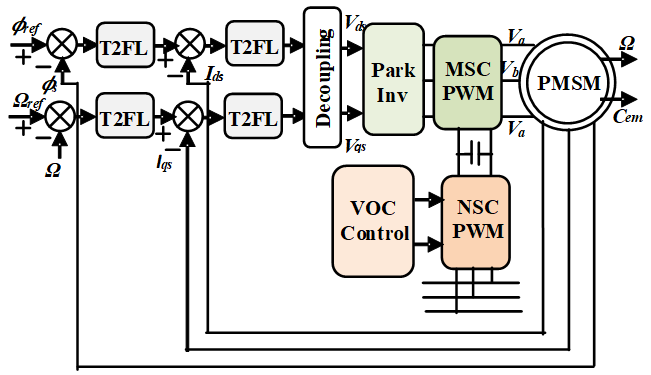
Introduction. Stator flow-oriented control is currently the most widely used system in industry or in previous research for improving the quality of mechanical power generated by permanent magnet synchronous motors (PMSM). Problem. However, this control is often based on PI controllers, which have shown problem limitations in terms of performance and robustness. Furthermore, these controllers are not suitable for variable-structure motors, which requires the use of new, more efficient controllers that provide robust control over both internal and external changes, such as type-2 fuzzy logic controllers. The goal of this work is to develop a stator flow-oriented control system by replacing PI controllers with type-2 fuzzy logic controllers that are robust to both external variations, such as changes in torque resistance, and internal variations, such as changes in parameters. Methodology. To implement this control on the PMSM, we maintained the similar structure of stator flow-oriented control, but replaced the PI controllers with type-2 fuzzy controllers. The results of numerical simulations performed using MATLAB/Simulink show that the stator flow-oriented control based on type-2 fuzzy logic controllers achieves an ideal response time and minimal overshoot, with an exponential error close to zero in both the transient and steady states, even with the application of external variations such as resistive torque or changes to the machine’s parameters. The scientific novelty of this work lies in replacing all the controllers in the stator flow-oriented control system with type-2 fuzzy controllers and their programming method, thus addressing the shortcomings of traditional methods. In addition, a rare type of comparative study is presented, thanks to which the effectiveness and robustness of the developed control method relative to other can be demonstrated. Practical value. The excellent results obtained with the new stator flow-oriented control method using type-2 fuzzy logic controllers suggest that it should be taught in academic circles and applied in industry. References 30, tables 3, figures 5.
References
Yazdan T., Humza M., Cho H.-W. Three-Phase Dual-Winding Multitasked PMSM Machine Using Double Layer Concentrated Winding for HEV Application. IEEE Access, 2023, vol. 11, pp. 36682-36691. doi: https://doi.org/10.1109/ACCESS.2023.3264568.
Thangavel S., Mohanraj D., Girijaprasanna T., Raju S., Dhanamjayulu C., Muyeen S.M. A Comprehensive Review on Electric Vehicle: Battery Management System, Charging Station, Traction Motors. IEEE Access, 2023, vol. 11, pp. 20994-21019. doi: https://doi.org/10.1109/ACCESS.2023.3250221.
Khowja M.R., Singh K., la Rocca A., Vakil G., Ramnathan R., Gerada C. Fault-Tolerant Dual Channels Three-Phase PMSM for Aerospace Applications. IEEE Access, 2024, vol. 12, pp. 126845-126857. doi: https://doi.org/10.1109/ACCESS.2024.3451705.
Li S., Xu Y., Zhang W., Zou J. A Novel Two-Phase Mode Switching Control Strategy for PMSM Position Servo Systems With Fast-Response and High-Precision. IEEE Transactions on Power Electronics, 2023, vol. 38, no. 1, pp. 803-815. doi: https://doi.org/10.1109/TPEL.2022.3200969.
Jin L., Mao Y., Wang X., Shi P., Lu L., Wang Z. Optimization-Based Maximum-Torque Fault-Tolerant Control of Dual Three-Phase PMSM Drives Under Open-Phase Fault. IEEE Transactions on Power Electronics, 2023, vol. 38, no. 3, pp. 3653-3663. doi: https://doi.org/10.1109/TPEL.2022.3222224.
Guezi A., Bendaikha A., Dendouga A. Direct torque control based on second order sliding mode controller for three-level inverter-fed permanent magnet synchronous motor: comparative study. Electrical Engineering & Electromechanics, 2022, no. 5, pp. 10-13. doi: https://doi.org/10.20998/2074-272X.2022.5.02.
Petkar S.G., Thippiripati V.K. A Novel Duty-Controlled DTC of a Surface PMSM Drive With Reduced Torque and Flux Ripples. IEEE Transactions on Industrial Electronics, 2023, vol. 70, no. 4, pp. 3373-3383. doi: https://doi.org/10.1109/TIE.2022.3181405.
Huang Y., Zhao M., Zhang J., Lu M. The Hall Sensors Fault-Tolerant for PMSM Based on Switching Sensorless Control With PI Parameters Optimization. IEEE Access, 2022, vol. 10, pp. 114048-114059. doi: https://doi.org/10.1109/ACCESS.2022.3218325.
Aib A., Khodja D.E., Chakroune S. Field programmable gate array hardware in the loop validation of fuzzy direct torque control for induction machine drive. Electrical Engineering & Electromechanics, 2023, no. 3, pp. 28-35. doi: https://doi.org/10.20998/2074-272X.2023.3.04.
Wadawa B., Errami Y., Obbadi A., Sahnoun S. Robustification of the H∞ controller combined with fuzzy logic and PI&PID-Fd or hybrid control of wind energy conversion system connected to the power grid based on DFIG. Energy Reports, 2021, vol. 7, pp. 7539-7571. doi: https://doi.org/10.1016/j.egyr.2021.10.120.
Sathish Babu P., Sundarabalan C.K., Balasundar C., Santhana Krishnan T. Fuzzy logic based optimal tip speed ratio MPPT controller for grid connected WECS. Materials Today: Proceedings, 2021, vol. 45, pp. 2544-2550. doi: https://doi.org/10.1016/j.matpr.2020.11.259.
Jasmine Gnana Malar A., Agees Kumar C., Gnana Saravanan A. Iot based sustainable wind green energy for smart cites using fuzzy logic based fractional order darwinian particle swarm optimization. Measurement, 2020, vol. 166, art. no. 108208. doi: https://doi.org/10.1016/j.measurement.2020.108208.
Verma P., Garg R., Mahajan P. Asymmetrical interval type-2 fuzzy logic control based MPPT tuning for PV system under partial shading condition. ISA Transactions, 2020, vol. 100, pp. 251-263. doi: https://doi.org/10.1016/j.isatra.2020.01.009.
Kececioglu O.F., Gani A., Sekkeli M. Design and Hardware Implementation Based on Hybrid Structure for MPPT of PV System Using an Interval Type-2 TSK Fuzzy Logic Controller. Energies, 2020, vol. 13, no. 7, art. no. 1842. doi: https://doi.org/10.3390/en13071842.
Benghanem M., Chettibi N., Mellit A., Almohamadi H. Type-2 fuzzy-logic based control of photovoltaic-hydrogen production systems. International Journal of Hydrogen Energy, 2023, vol. 48, no. 91, pp. 35477-35492. doi: https://doi.org/10.1016/j.ijhydene.2023.05.360.
Zellouma D., Bekakra Y., Benbouhenni H. Field-oriented control based on parallel proportional–integral controllers of induction motor drive. Energy Reports, 2023, vol. 9, pp. 4846-4860. doi: https://doi.org/10.1016/j.egyr.2023.04.008.
Khanday S.A., Bhat A.H., Sekhar O.C. Performance Analysis of Space Vector Approach Based Field Oriented Control of Indirect Matrix Converter Fed PMSM Drive. 2023 7th International Conference on Computer Applications in Electrical Engineering-Recent Advances (CERA), 2023, pp. 1-6. doi: https://doi.org/10.1109/CERA59325.2023.10455147.
Wu T., Lyu M., Wu X., Yang M., Wang Y., Huang S., Ouyang X., Rodriguez J. Enhanced Model Predictive Control for PMSM Based on Reference Voltage Predictive Model. IEEE Journal of Emerging and Selected Topics in Power Electronics, 2023, vol. 11, no. 5, pp. 5290-5300. doi: https://doi.org/10.1109/JESTPE.2023.3307469.
Hossain M.S., Said N.A.M., Hasan M.A., Halim W.A., Munim W.N.W.A., Jidin A. Performance evaluation of a nearest level control-based TCHB multilevel inverter for PMSM motors in electric vehicle systems. Results in Engineering, 2025, vol. 25, art. no. 103949. doi: https://doi.org/10.1016/j.rineng.2025.103949.
Benzouaoui A., Khouidmi H., Bessedik B. Parallel model predictive direct power control of DFIG for wind energy conversion. International Journal of Electrical Power & Energy Systems, 2021, vol. 125, art. no. 106453. doi: https://doi.org/10.1016/j.ijepes.2020.106453.
Zamzoum O., Derouich A., Motahhir S., El Mourabit Y., El Ghzizal A. Performance analysis of a robust adaptive fuzzy logic controller for wind turbine power limitation. Journal of Cleaner Production, 2020, vol. 265, art. no. 121659. doi: https://doi.org/10.1016/j.jclepro.2020.121659.
Acikgoz H., Yildiz C., Coteli R., Dandil B. DC-link voltage control of three-phase PWM rectifier by using artificial bee colony based type-2 fuzzy neural network. Microprocessors and Microsystems, 2020, vol. 78, art. no. 103250. doi: https://doi.org/10.1016/j.micpro.2020.103250.
Kou L., Liu C., Cai G., Zhang Z., Zhou J., Wang X. Fault diagnosis for three-phase PWM rectifier based on deep feedforward network with transient synthetic features. ISA Transactions, 2020, vol. 101, pp. 399-407. doi: https://doi.org/10.1016/j.isatra.2020.01.023.
Darsouni Z., Rezgui S.E., Benalla H., Rebahi F., Boumendjel M.A.M. Ensuring service continuity in electric vehicles with vector control and linear quadratic regulator for dual star induction motors. Electrical Engineering & Electromechanics, 2025, no. 2, pp. 24-30. doi: https://doi.org/10.20998/2074-272X.2025.2.04.
Kuczmann M., Horvath K. Tensor Product Alternatives for Nonlinear Field-Oriented Control of Induction Machines. Electronics, 2024, vol. 13, no. 7, art. no. 1405. doi: https://doi.org/10.3390/electronics13071405.
Khemis A., Boutabba T., Drid S. Model reference adaptive system speed estimator based on type-1 and type-2 fuzzy logic sensorless control of electrical vehicle with electrical differential. Electrical Engineering & Electromechanics, 2023, no. 4, pp. 19-25. doi: https://doi.org/10.20998/2074-272X.2023.4.03.
Rouabhi R., Herizi A., Djeriou S., Zemmit A. Hybrid type-1 and 2 fuzzy sliding mode control of the induction motor. Revue Roumaine des Sciences Techniques Serie Electrotechnique et Energetique, 2024, vol. 69, no. 2, pp. 147-152. doi: https://doi.org/10.59277/RRST-EE.2024.2.5.
Srinivas G., Durga Sukumar G., Subbarao M. Total harmonic distortion analysis of inverter fed induction motor drive using neuro fuzzy type-1 and neuro fuzzy type-2 controllers. Electrical Engineering & Electromechanics, 2024, no. 1, pp. 10-16. doi: https://doi.org/10.20998/2074-272X.2024.1.02.
Rouabhi R., Zemmit A., Herizi A., Moussa O., Djeriou S. Hybrid type-2 fuzzy backstepping control of doubly fed induction generator for wind energy conversion systems. Journal of the Brazilian Society of Mechanical Sciences and Engineering, 2025, vol. 47, no. 1, art. no. 24. doi: https://doi.org/10.1007/s40430-024-05293-z.
Rouabhi R., Herizi A., Djerioui A. Performance of Robust Type-2 Fuzzy Sliding Mode Control Compared to Various Conventional Controls of Doubly-Fed Induction Generator for Wind Power Conversion Systems. Energies, 2024, vol. 17, no. 15, art. no. 3778. doi: https://doi.org/10.3390/en17153778.
Downloads
Published
How to Cite
Issue
Section
License
Copyright (c) 2026 M. Tabbakh, R. Rouabhi, A. Herizi, N. Chami

This work is licensed under a Creative Commons Attribution-NonCommercial 4.0 International License.
Authors who publish with this journal agree to the following terms:
1. Authors retain copyright and grant the journal right of first publication with the work simultaneously licensed under a Creative Commons Attribution License that allows others to share the work with an acknowledgement of the work's authorship and initial publication in this journal.
2. Authors are able to enter into separate, additional contractual arrangements for the non-exclusive distribution of the journal's published version of the work (e.g., post it to an institutional repository or publish it in a book), with an acknowledgement of its initial publication in this journal.
3. Authors are permitted and encouraged to post their work online (e.g., in institutional repositories or on their website) prior to and during the submission process, as it can lead to productive exchanges, as well as earlier and greater citation of published work.